
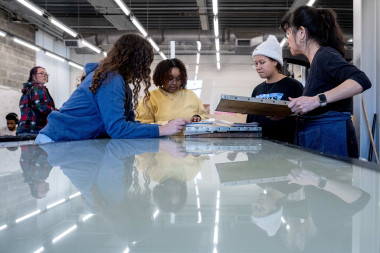
Faculty and students in printmaking class
Collection

From Class to Community: Centering Trust in Learning Spaces

A collaborative classroom doesn’t happen by accident; it's created by design. Use these tools to lower resistance, foster trust, and help students learn with one another rather than just from you.

Updated May 2025
Brielle Harbin headshot
Fellow
University of Pennsylvania
View Bio
01

Knowing Students’ Names is Important, but Figuring This Out is a Game-changer for Building Classroom Community.

Notes From A Work Friend

In this blog post, Dr. Brielle Harbin describes a single question you can ask your students that will help you build trust, navigate difficult conversations, and design a more inclusive classroom community, even when disagreement is inevitable.
Headshot of Brielle Harbin
Brielle Harbin

If you’ve ever found yourself wrestling with how to build genuine connection in a classroom—especially one where difficult or emotionally charged topics are on the syllabus—this post is worth your time. This post centers on a deceptively simple assignment: asking students to list the three most important things to know about them. It’s not flashy. It’s not particularly time-consuming. But it’s offered real insight in classrooms where consensus is unlikely, and where students need to feel seen before they’re willing to speak.

View excerpt

While I agree that knowing students’ names is critical to building a thriving classroom community, I consider it a starting point toward the bigger and broader goal: creating a learning environment where students trust you, are willing to take risks, and are invested in what happens and classroom outcomes. In my experience, the latter work requires much deeper and more deliberate effort on the instructor’s part.
Was this resource helpful?
02

Icebreaker: ‘How Does Your Family Cook Rice?’

Good Food

In this podcast interview, Dr. Amber Spry shares a classroom activity she created that helps spark intercultural dialogue and prepares students to openly and thoughtfully interact with one another from the very first class meeting.

Headshot of Brielle Harbin
Brielle Harbin

At first glance, asking students how their family or culture cooks rice might seem simple—even obvious. But as someone who has taught emotionally charged and identity-centered courses, I know how powerful it can be to begin with a shared experience that invites difference without defensiveness.

What I love about this strategy is that it centers cultural humility, models perspective-taking, and invites students to speak from a place of lived knowledge before we ever ask them to weigh in on more abstract or politicized content. It communicates early on: Your experience matters here. And so does your curiosity about others.

View excerpt

I designed an activity to address these challenges by encouraging students to provide their perspective on a shared experience during the first week of class. The activity, called the RiceBreaker, asks students to answer a straightforward question: “how does your family or your culture cook rice?” By using the example of a simple ingredient found across the globe, the activity demonstrates how students can hold different perspectives on the same topic based on their own experiences, and models for the class how to approach conversation throughout the semester when perspectives on a given topic may vary. This activity encourages students to develop a framework for incorporating differing viewpoints and engage with ideas to which they may have had limited exposure.

Was this resource helpful?
03

Teaching Students How to Have Healthy Conversations

TedX Talks

In this TEDx Talk, journalist Celeste Headlee makes a compelling case that conversational competence may be the most overlooked—and most essential—skill we fail to teach young people.

Headshot of Brielle Harbin
Brielle Harbin

This talk is a powerful reminder that building a healthy, collaborative classroom community isn’t just about content—it’s about teaching students how to truly hear one another.

View excerpt

Building a strong classroom community requires that students not only know how to speak—but how to truly listen to one another. In this TEDx Talk, journalist Celeste Headlee shares 10 practical, memorable rules that center active listening, thoughtful questioning, and staying present. I assign this video at the start of the semester to spark a conversation with my students regarding what it means to engage in dialogue that strengthens—not splinters—our learning environment. When breakdowns occur, we now have a common language to name what’s happening and troubleshoot together. This lowers the stakes of disagreement and offers us a clear, compassionate path forward when conflict arises.

Was this resource helpful?
04

Navigating "Access Friction" in Teaching

Beyond the Scope

In this blog post, Dr. Sarah Silverman thoughtfully explores a complex reality that often surfaces when creating inclusive classrooms: competing access needs. Silverman lowers the stakes of building an inclusive classroom by framing this work as an ongoing, collaborative process that honors both student and instructor needs.

Headshot of Brielle Harbin
Brielle Harbin

The term access friction invites us to move beyond box-checking and tip-sheet approaches to inclusion, and instead grapple with the layered, sometimes conflicting needs that arise in real learning environments. Tracing the history and evolving use of the term, Silverman frames inclusion as an ongoing, collaborative process—one that honors both student and instructor needs as part of the broader classroom community.

View excerpt

How should we respond to access friction that arises in our classrooms? How should faculty developers address the existence of access friction with instructors? A point that I have learned from disability justice organizers is that access needs may appear to be opposing or conflicting, but we do not need to view them as “in competition” as long as all members of the community are willing to work towards a solution together.

Was this resource helpful?
05

Enhancing Trust and Embracing Vulnerability in the College Classroom

Teaching & Learning Inquiry

In this essay, Drs. Meinking and Hall offer a real-world account of the work required to cultivate trust and vulnerability when building an inclusive classroom community.

Headshot of Brielle Harbin
Brielle Harbin

This reflective essay offers a thoughtful, real-world account of what it means to build an inclusive classroom community through the practices of ungrading and co-creation. The authors don’t just describe new strategies—they share how leaning into trust and vulnerability with their students created space for deeper connection, shared authority, and meaningful collaboration. If you’re exploring ways to reimagine how power and partnership show up in your classroom, this piece offers both inspiration and honest insight into what that work can feel like in practice.

View excerpt

Trust must be felt on the part of an instructor who makes evidence-based decisions about pedagogy rooted in the scholarship of teaching and learning, between instructors in co-teaching course contexts, between instructors and students (i.e., instructors trusting students), between students and instructors (i.e., students trusting instructors), and between the students and their peers. While instructors can make specific, intentional moves to develop the trust of their students (Felten et al., 2023), in the ungraded CCTL classroom, trust needs to be reciprocal and shared amongst all course participants.

Was this resource helpful?
06

The Power of Pausing on Student Learning

Notes From A Work Friend

In this reflective post, Dr. Brielle Harbin shares how one small shift—a well-timed pause—sparked deeper student thinking and richer classroom dialogue. You'll walk away with an easy-to-implement strategy for helping students discover misconceptions, identify learning gaps, and stay engaged during the most exhausting part of the semester.

Headshot of Brielle Harbin
Brielle Harbin

This post offers a timely and refreshingly honest look at what it means to teach during times of fatigue—both our students’ and our own. Drawing on grounded insight, Dr. Harbin models how a simple pause can deepen student engagement, spark meaningful reflection, and shift a classroom from passive review to active and invested learning. If you’re feeling the weight of the semester and wondering how to reconnect with your students (and yourself), this post offers a blueprint.

View excerpt

I noticed several students staring into the air, erasing and rewriting their responses.

I asked one student who looked especially invested, and she explained, “I was certain I could do it when you asked, but now that I’m doing it, I realize it’s more tricky than I realized.” TEACHING WIN!

Was this resource helpful?

Want to recommend a resource to add to this collection? Send us an email.