Different colored signposts, pointing in different directions
Collection

Specifications Grading Example Grading Schemes

These annotated examples of specifications grading schemes can serve as models for your own design. Taken together, the examples illustrate the variety of approaches and emphases that are possible within specs grading.

Updated May 2026
Adriana Streifer headshot
Associate Director & Associate Professor
Office of the Executive Vice President and Provost
View Bio

First-Year Seminar: Falling From Infinity

Michael Palmer

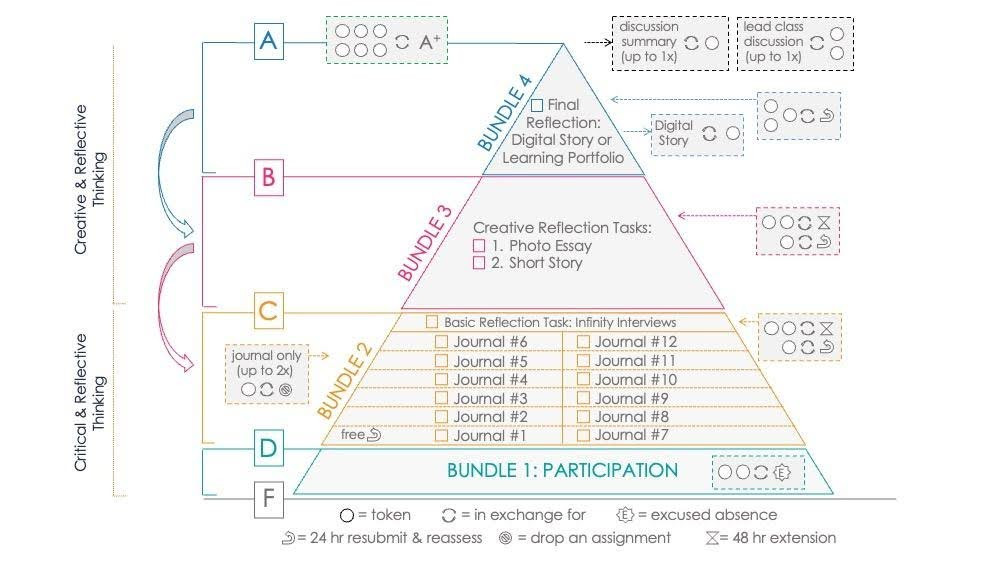
This specs grading scheme comes from an interdisciplinary first-year seminar about infinity. The scheme prioritizes different learning objectives at each grade level, and encourages students to strive for more complex ones by completing higher-level assignments to qualify for plus grades.

Headshot of Adriana Streifer
Adriana Streifer

I appreciate this specs scheme for its simplicity and strong alignment with learning objectives – it creates one bundle of assignments per grade level. The scheme also provides multiple ways to lower the stakes on each assignment, including a novel “cascade effect.”

View excerpt

Specs Grading Approach: The design of this specs scheme prioritizes a set of foundational learning objectives while encouraging students to engage in more complex ones. The low-stress environment created through choice, flexibility, and revisions allows students to focus on pursuing topics and questions that matter to them rather than worry about the grade.
Was this resource helpful?

English Literature: Identity, Race, and Religion in Renaissance Drama

Adriana Streifer

This specs grading scheme comes from an English literature seminar that introduces students to the English major and fulfills a University writing requirement. The scheme differentiates grade levels both by the quantity and complexity of assignments.

Headshot of Adriana Streifer
Adriana Streifer

This is my own course! The specs scheme will be a useful model to you if you want to design a scheme that prioritizes sustained engagement and participation at all grade levels. The scheme also offers students a lot of flexibility.

View excerpt

Specs grading approach: The design of this specs scheme differentiates between quantity of work and complexity/difficulty of work relative to each grade level. It also emphasizes certain course objectives more strongly at different grade levels.

With its emphasis on student choice, flexibility, and revision, specs grading is well-suited to the goals of emphasizing writing as a process, and to reducing students' writing anxieties.

Was this resource helpful?

Nursing/Psychology: Science and Practice of Mindfulness and Compassion

Dorothe Bach

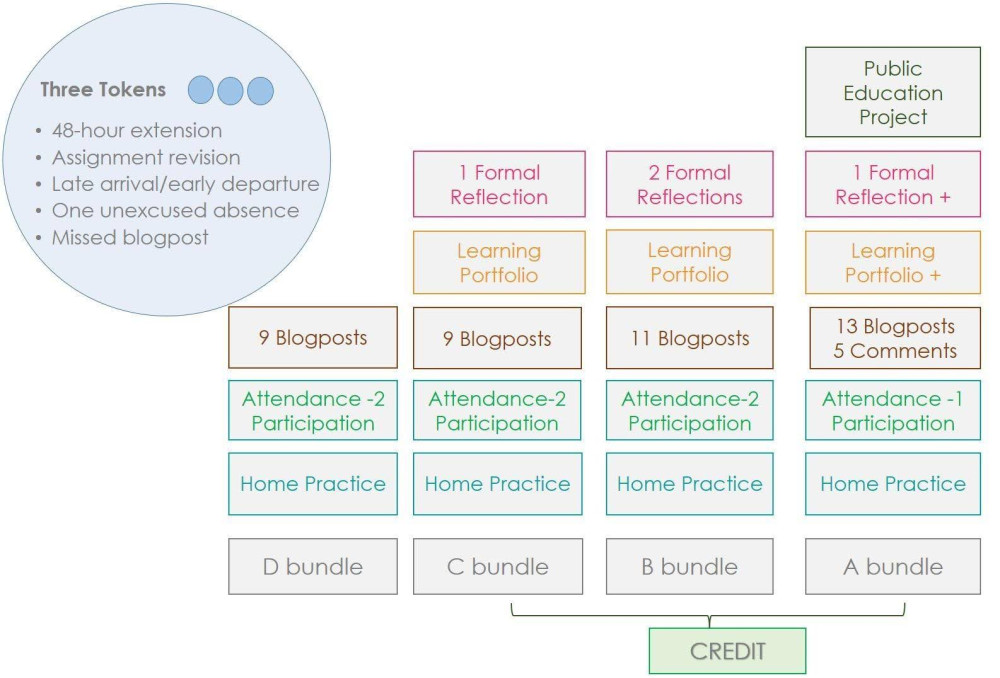
This specs scheme comes from an upper-level, practice-oriented course. It differentiates between grade levels by emphasizing different learning objectives, and through quantity and complexity of work. It frames learning and grades in terms of students’ choices, and encourages risk taking.

Headshot of Adriana Streifer
Adriana Streifer

I like this grading scheme because it foregrounds student agency in its design. I also appreciate its incorporation of non-traditional, experiential assignment types (such as the “home practice” assignment, in which consistent doing, rather than evaluation of quality, is the point).

See my annotations on the document for more thoughts on this grading scheme.

View excerpt

Specs grading approach: The design of this specs scheme differentiates between quantity of work and complexity/difficulty of work relative to each grade level as well as rewards risk-taking through a public education project. It also emphasizes certain course objectives more strongly at different grade levels. Students can choose to take this elective as a credit/no credit (pass/fail) course or for a grade. The specs grading scheme with its emphasis on student choice and flexibility is ideally suited to accommodate different motivations that students bring to the course (i.e. interest in mindfulness for stress-reduction vs. interest in the practice and the science of mindfulness).

Was this resource helpful?

Biomedical Engineering: Bioelectricity

Brian Helmke

The excerpts from this syllabus provide an example of an effective specifications grading scheme in an upper-level STEM course.

Headshot of Adriana Streifer
Adriana Streifer

Two things I love about this specs grading scheme are that the token system encourages metacognitive thinking, and the assignments specs are process oriented. These design features can shift students’ thinking beyond right/wrong answers, to include attention to their learning strategies.

See my annotations on the document for more thoughts on this grading scheme.

Was this resource helpful?

Want to recommend a resource to add to this collection? Send us an email.