
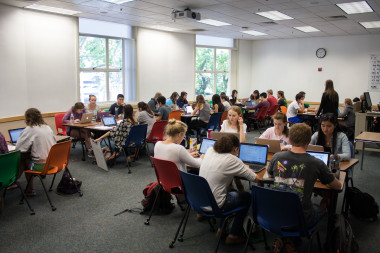

A classroom filled with students seated at grouped tables, working on laptops and papers during a class session, while an instructor stands at the front.
Collection

Essentials for Collaborative Learning Groups

Whether you're organizing informal in-class groups or assigning out-of-class group projects, it takes care to make group work run well. This collection features our favorite resources for supporting students through sustained collaboration in persistent or ephemeral learning groups.

Updated January 2026
Lynn Mandeltort headshot
Assistant Director of Engineering Education Initiatives & Assistant Professor
Office of the Executive Vice President and Provost
View Bio
Lindsay Wheeler headshot
Senior Associate Director & Associate Professor
Office of the Executive Vice President and Provost
View Bio
01

Essential questions (and answers!) for designing team-based projects

University of Minnesota Center for Educational Innovation

Are you considering using a team project in your course? This UMN resource walks through the stages of planning you’ll need as you design and implement your students’ collaborative assignments.


Headshot of Lynn MandeltortHeadshot of Lindsay Wheeler
Lynn Mandeltort, Lindsay Wheeler

We love how this resource is pitched as numbered steps but also has depth if you keep clicking. There are plenty of examples and literature references, too

View excerpt

Faculty Guide to Team Projects

University of Minnesota Center for Educational Innovation
Open resource

Manage student expectations for their team project 

How you introduce the team project to your students can affect their attitude towards the project. Some students may feel ambivalent or even have a negative reaction when the instructor announces a team project. Oftentimes, this is because they have had a prior negative experience with a team project or because they don’t fully understand the purpose of the current project, or they aren't sure how the project will benefit them in now or later. Understanding the causes of student resistance to teamwork helps us to address concerns and lay a foundation from which learners can to invest emotionally and academically in the project.

  • Tell students on the first day of class (or before class) that they will be working on a team project. Include this information in the course syllabus. A syllabus statement is one way to do this.
  • Elicit student attitudes towards teamwork on the first day of class. You could ask them about their previous experiences in teamwork have been, both good and bad. This can take the form of an online or paper survey, small group discussions, or a whole class discussion. Be sure to ask students to share specific examples of the good and bad, and to suggest what they would change to convert something bad to something better. Collect and display the information you receive and use this to facilitate a conversation about what they would like from their fellow students and the instructor to ensure that their project will be successful.
  • Be transparent. Ensure that you and your students share an understanding of what effective teamwork looks like and show them how the project fits into your course learning outcomes. It is also helpful to be transparent about the assignment's purpose, intended audience, and the tasks they will be required to complete along the way.

Was this resource helpful?
02

An entire book with ideas for collaborative student work

Elizabeth F. Barkley, Claire H. Major, and K. Patricia Cross

This easy-to-navigate guide describes thirty-five creative assignments for groups. With chapter titles like "Designing the Learning Task," "Forming Groups," and "Techniques for Discussion," it articulates the whys and hows of different collaborative assignment types and includes plenty of examples.

Headshot of Lynn MandeltortHeadshot of Lindsay Wheeler
Lynn Mandeltort, Lindsay Wheeler

When we’re talking with instructors about collaborative learning, this is almost always the first resource we share. It’s replete with collaborative engagement ideas that align with different pedagogical purposes and contexts. We especially love how the examples are organized by an instructor's reason for using groups: techniques for reciprocal teaching, problem-solving, discussion, etc. Whether you’re looking for input on a collaborative practice you're already using or starting from scratch, this book is a great companion to your teaching.

View excerpt

Collaborative Learning Techniques

Elizabeth F. Barkley, Claire H. Major, and K. Patricia Cross
Open resource

CoLT Categories

To reduce the effort required to locate an appropriate CoLT, we have organized the techniques into six broad categories:

  • Discussion - Student interaction and exchange is achieved primarily through spoken words.
  • Reciprocal Peer Teaching - Students purposefully help each other master subject matter content and develop discipline-based skills.
  • Problem Solving - Students focus on practicing problem-solving strategies.
  • Graphic Information Organizers - Groups use visual tools to organize and display information. Writing Students write to learn important course content and skills.
  • Games - Students work together in teams to participate in a competitive activity that is guided by a preexisting set of rules.

These categories represent our best attempt at sorting the techniques into sets that share fundamental commonalities, yet the dividing lines are not precise. For example, in the writing CoLTs we include CoLT 27: Peer Editing. This is a technique in which students critically review and provide editorial feedback on each other's essay, report, argument, research paper, or other writing assignment. One could make a case that this technique might be better included in reciprocal peer teaching, but we included it in the writing section because students write a response to another student's paper and thus learn to evaluate their own work.

Was this resource helpful?
03

Examples of collaborative learning in context

Rush University Center for Teaching Excellence and Innovation

In this podcast episode, four faculty from different disciplines discuss their approaches to group assignments: what is "suitable" for groups, how to ensure equitable participation, and how they approach assessing group work.

Headshot of Lynn MandeltortHeadshot of Lindsay Wheeler
Lynn Mandeltort, Lindsay Wheeler

We (Lindsay and Lynn) were stoked to be invited to this conversation, to chat about our work and hear from the other guests. The conversation covers a lot of contextual and implementation ground: you'll hear about hands-on group projects, online collaboration, and highly structured in-class work. We recommend listening because everyone's teaching context is different, and hearing one instructor walk through their process can help you cement your own or ask yourself important questions. Listeners might especially appreciate Prabhani Kuruppumullage's comments about groupwork in the context of asynchronous learning, where students are choosing to learn online for scheduling flexibility around their other life obligations.

View excerpt

The Art of Group Work: Strategies for Effective Collaborations (podcast)

Rush University Center for Teaching Excellence and Innovation
Open resource

"There's no perfect way to configure student groups, and that just circles back to those big contextual challenges, or situational factors that we have when we're designing our classes. I remember Prabhani mentioning students in different time zones. How do you have students work in groups when they're in different time zones? Maybe you want to group your students based on time zone or help them get together based on their availability. This happened to me when I was teaching a course with a lot of student athletes where they had really restricted free time. And so those kinds of things are ways that we can imagine configuring student groups... prioritizing those biggest issues that are going to have be hurdles for students in our teaching... as much as we can lower the logistical barriers to helping them do that hard work of working together,

"I use a mix of individual and collective assessments. Because, in my the way that I look at it is the group project is there to sort of facilitate student interactions and to improve individual understanding. Because...in statistics classes, specifically, we have students coming from very diverse backgrounds, and because they might also be taking different types of statistics classes when they're actually coming towards the capstone class. So the group project would require them to interact with each other and maybe perhaps even teach each other some of the things... If you just use individual assessments, I think that would discourage people from interacting. But on the other hand, if you only have collective assessments, then that could be somewhat unfair to stronger students. So I think a mix would be the way to go. "

Was this resource helpful?
04

Anticipating common challenges of group work

Carnegie Mellon Eberly Center

What are the challenges of group work and how can I address them? This article provides the potential challenges students face and provide various strategies to address these challenges. Also included are a list of potential challenges for instructors to consider when implementing collaborative learning.

Headshot of Lynn MandeltortHeadshot of Lindsay Wheeler
Lynn Mandeltort, Lindsay Wheeler

This is a succinct list of student challenges and strategies that instructors may find useful when designing collaborative learning experiences for students. You can use the other resources in this collection to dig deeper into the proposed strategies. There are also some great practical resources for group projects on this site!

View excerpt

Unfortunately, groups can easily end up being less, rather than more, than the sum of their parts. Why is this?

In this section, we consider the hazards of group projects and strategies instructors can use to avoid or mitigate them. Find other strategies and examples here or contact the Eberly Center for Teaching Excellence for help.

For students, common challenges of group work include:

  • Coordination costs
  • Motivation costs
  • Intellectual costs

For instructors, common challenges involve:

  • Allocating time
  • Teaching process skills
  • Assessing process as well as product
  • Assessing individual as well as group learning

Was this resource helpful?
05

Group work guidance for students

University of Minnesota College of Continuing & Professional Studies

This unique, student-facing resource contains helpful phrases that students can use when faced with common collaboration or discussion scenarios.

Headshot of Lynn MandeltortHeadshot of Lindsay Wheeler
Lynn Mandeltort, Lindsay Wheeler

If you've ever had students express uncertainty about working with their peers, this is a great resource to consult. This set of common phrases can empower students to advocate for themselves and use simple communication to work with their peers– it can be useful alongside your own transparent assignment instructions to help students navigate working together. You might even find some of the phrases helpful in your teaching. See also our collection on instructor language.

View excerpt

Group Work/Projects

University of Minnesota College of Continuing & Professional Studies
Open resource

At some point in your education, you will likely be asked to work on a group project with your classmates or with a partner. You may be asked to take on a certain role or perform a specific task to complete the project. 

Working on a team is different than working on your own. We have some suggestions to help you contribute and feel like part of the group.

The Pace is Too Fast

If your group members are talking quickly, it's okay to ask questions to clarify what they said:

"Sorry, I didn't catch that."

"Could you repeat that?"

"Can you explain that?"

"What do you mean by…?"

Was this resource helpful?
06

What does the research say about implementing group work?

CBE-Life Sciences Education

This brilliant flow chart can help you organize the many possible decisions for student collaboration while also pointing to the relevant research.

Headshot of Lynn MandeltortHeadshot of Lindsay Wheeler
Lynn Mandeltort, Lindsay Wheeler

We recommend this for instructors who are looking for either: an overview of how to conceptualize group work (maybe you’re very new to this and a concept map could help you get started) OR instructors with lots of experience who are ready for a deeper dive into the origins of common recommendations around group work (maybe you’d like to see how your approach relates to what else is out there). The clickable visual layout gives instructors many options to dive deep and still stay connected to the overarching idea.

Was this resource helpful?

Want to recommend a resource to add to this collection? Send us an email.