

Female students talking, participating in class discussion
Collection

Holistic Approaches to Learning Objectives

Do you find that your course learning objectives don't fully capture the goals you and your students have for their learning and development? This collection points to a variety of frameworks for developing more holistic learning, where the humanity of our students is at the center.

Updated August 2025
Chris Creighton headshot
Instructional Designer
University of Colorado Colorado Springs
View Bio
01

Humanizing Learning: My Hopes

Chris Creighton

Taking a humanistic perspective, this post takes a thoughtful and student-centered approach to developing learning in a course. Read before exploring the other resources.

Headshot of Chris Creighton
Chris Creighton

I wrote this piece to create a shared grounding resource - my hopes for you as you engage with developing learning goals, objectives, and questions. I really emphasize a holistic approach, one that foregoes compartmentalizing and disconnecting both ourselves and knowledge. As we are in a critical time for education worldwide, critically countering prevailing narratives is necessary as we dream up a future of good education. I hope you read this piece first before diving into the other resources in this collection.

View excerpt

What makes a question worth chasing? What makes an idea worth exploring? How do these learning experiences contribute to a life worth living? These three questions, the first as posed by Angela Stockman, seek to engage a holistic approach to learning where the humanity of our students is at the center. I hope your students seek to engage you when you think about the purpose of your course. Your course exists for reasons that are not only tied to particular curriculum sequencing or a pre-determined career pathway, but also to the development of who your students are to be after the course ends.
Was this resource helpful?
02

Essential Questions

Jay McTighe and Grant Wiggins

Expanding on the book Understanding by Design, the authors Wiggins and McTighe present Essential Questions as a standalone resource on developing and using questions to build students' understanding.

Headshot of Chris Creighton
Chris Creighton

As I work with faculty on their learning objectives, I have found that blending in questions with the objectives allows faculty to gain a greater conception of their course design and flow of the curriculum. Essential Questions provides excellent framing for the development of the course questions and provides detailed discussion as to their usage for those who might not want to incorporate their exact prescription. When crafting questions, consider what makes a question worth chasing.

View excerpt

If the content you are expected to teach represents "answers," then what questions were being asked by the people who came up with those answers? This conceptual move offers a useful strategy both for seeing a link between content standards and important questions and for coming up with ways of engaging students in the very kind of thinking that is required to truly understand the content. In short, expert knowledge is the result of inquiry, argument, and difference of opinion; the best questions point to hard-won big ideas that we want learning to come to understand. The questions thus serve as doorways or lenses through which learners can better see the key concepts, themes, theories, issues, and problems that reside within the content.

Was this resource helpful?
03

Branches From the Same Tree: A Scoping Review of Learning Outcomes Frameworks

Intersection: A Journal at the Intersection of Assessment and Learning

The authors conducted a scoping review, creating a crosswalk between existing learning outcomes and assessment frameworks and identifying gaps, developed the Evidence of Learning and Impact Framework.

Headshot of Chris Creighton
Chris Creighton

The article presents a wonderful collection of learning outcome frameworks and taxonomies. The authors include many holistic approaches from Miller's "Whole Person" Model to the indigenous Medicine Wheel, incorporating learning realms from cognitive to spiritual. Specifically, they make note of which ones consider diverse ways of knowing.

View excerpt

Branches From the Same Tree: A Scoping Review of Learning Outcomes Frameworks

Intersection: A Journal at the Intersection of Assessment and Learning
Open resource

Learning outcomes and assessment frameworks guide educators in curricular decision-making, impact assessment, gap identification, and equity evaluation, aligning with anticipated learning objectives. Common frameworks include Bloom’s taxonomy, Kirkpatrick's model, Fink’s taxonomy, and Moore’s Outcomes model. The authors identified a lack of focus on learners’ impact and social justice in these frameworks and developed the Evidence of Learning and Impact Framework to address these gaps. They conducted a scoping review, creating a crosswalk between existing frameworks and identifying additional gaps. Findings from the review and crosswalk are presented, discussing the challenges of incorporating frameworks from the Global South into a more rigid structure. The review synthesizes previous knowledge and highlights the importance of multidisciplinary approaches and diverse ways of knowing.

Was this resource helpful?
04

Barre's Taxonomy of Learning Goals

Elizabeth Barre

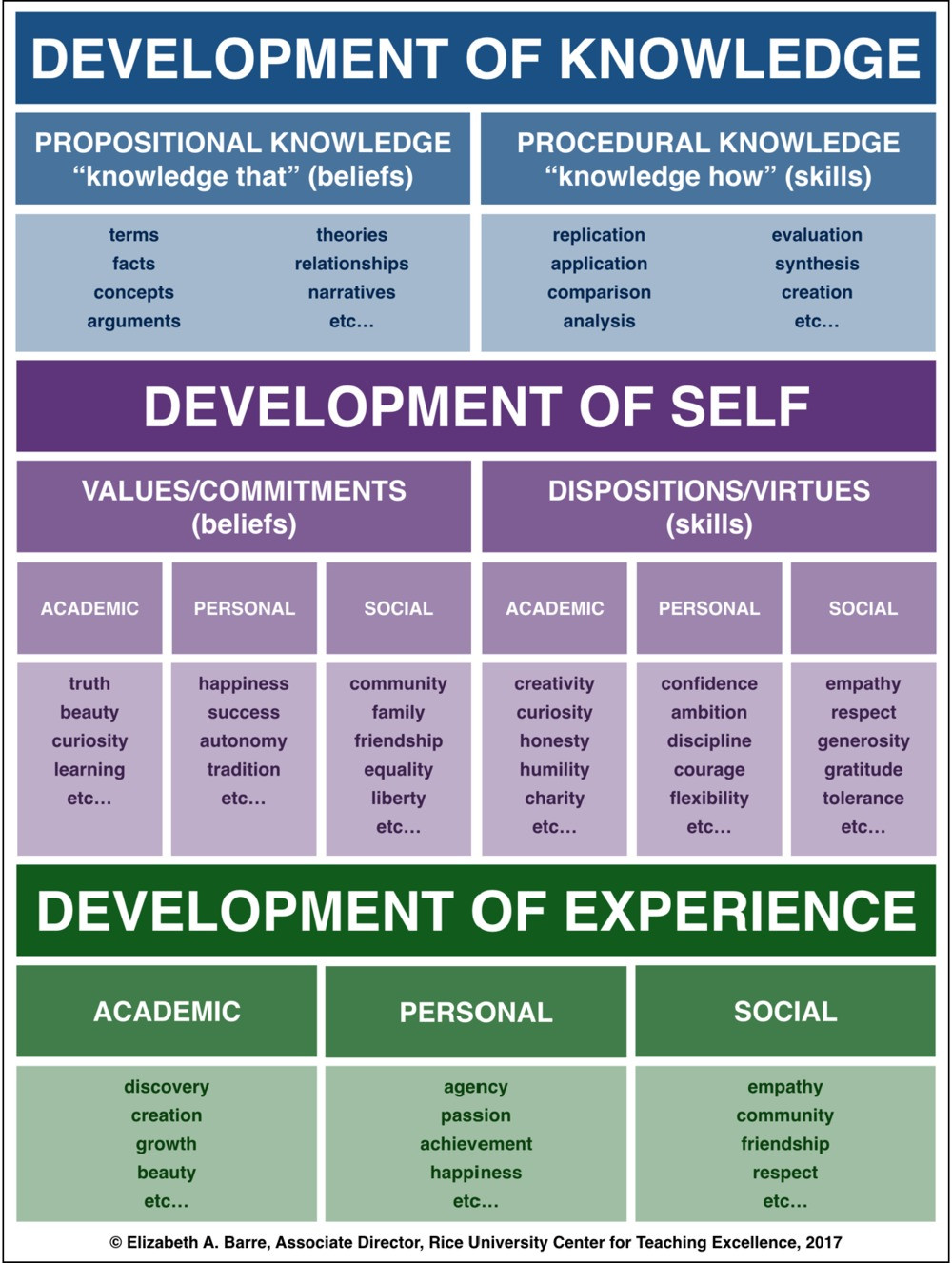
In a blog post and based on her experiences, Elizabeth Barre sets out a new taxonomy of learning goals with the broad, general framing that we are developing students.

Headshot of Chris Creighton
Chris Creighton

When this resource was first sent to me via Liz Norell from Josh Eyler, I was enthralled. With the focus on developing students more broadly, not just conveying and scaffolding information, I found this approach to be much more student-centered than most taxonomies. I have found it particularly useful with faculty who co-create aspects of their courses with students in structuring the experiences.

View excerpt

Helping faculty think through what they value in the context of their courses is my favorite part of course design. But I have to confess that the traditional taxonomies I use when doing so have never made much conceptual sense to me. So after many years of introducing these categories with the caveat that we shouldn't think too hard about them, I finally decided to create my own. I didn't think the world needed yet another taxonomy of learning goals, but I thought I would do a better job talking with faculty if I could present the alternatives in my own vernacular. And it turns out they liked it enough to insist that I share.

When I sat down to do this, I began with a basic assumption: that teaching is many things but, at its core, it is ultimately about helping our students to develop in various ways. A focus on development makes my taxonomy a bit broader than those that emphasize learning, but that is intentional. When most of us think of the word "learning," we think of a very narrow range of activities and outcomes. But we often hope to achieve many other things when we teach, and a focus on development can give us room to be more intentional about folding those goals into our course planning. More specifically, my taxonomy helps us to think about our teaching in terms of three broad developmental goals: the development of knowledge, the development of self, and the development of experiences.

Was this resource helpful?
05

Crafting Standards for Standards-Based Grading

Grading for Growth

This post contains frequently asked questions about constructing and using standards in standards-based grading systems.

Headshot of Chris Creighton
Chris Creighton

My first encounter with learning objectives was actually constructing standards for a standards-based grading system. To me, it was intuitive. The standards served a direct assessment purpose blending the curriculum of mathematics with assessment categories... which is how many in math think about the curriculum.

View excerpt

At its core, SBG is grading at the level of individual skills or topics. SBG classes include a list of standards that describe the key things that students will learn in class. These are generally discrete skills – skills that can be practiced and demonstrated separately from each other. More specifically:

A standard is a clear and observable description of an action that a student can take to demonstrate their learning of some specific topic.

For example, here is a standard from the Calculus 2 class I’m currently teaching. We’ll be learning about this next week:

D.3: I can solve separable differential equations and initial value problems.

Was this resource helpful?
06

Webb's Depth of Knowledge

Edutopia

This article explores how Depth of Knowledge can help instructors evaluate the cognitive complexity of a task or assignment. It's often used in conjunction with learning objectives.

Headshot of Chris Creighton
Chris Creighton

I have found Depth of Knowledge (DOK) to be a great framework to use in conjunction with learning outcomes or questions. It is helpful to get a good sense, evaluatively, of how complex the task is that students are performing. It is both useful for teachers and students to use to gauge not only how complex the assignment is, but also their own understanding of the subject. To what level of DOK does your work rise to?

View excerpt

To use DOK in your practice, start by looking at the standards (or other learning objectives) that anchor a lesson. What is the complexity of cognitive engagement required for success? When interpreting a standard, you can use the full DOK definitions for a specific content area. These general key questions can also help:

DOK 1: Is the focus on recall of facts or reproduction of taught processes?

DOK 2: Is the focus on relationships between concepts and ideas or using underlying conceptual understanding?

DOK 3: Is the focus on abstract inference or reasoning, nonroutine problem-solving, or authentic evaluative or argumentative processes that can be completed in one sitting?

DOK 4: Is the focus at least with the complexity of DOK 3, but iterative, reflective work and extended time are necessary for completion?

Was this resource helpful?
07

Hess's Cognitive Rigor Matrix

Karin K. Hess, Ben S. Jones, Dennis Carlock, and John R. Walkup

The article presents an example use case of Hess's Cognitive Rigor Matrix blending Bloom's Taxonomy with Webb's Depth of Knowledge. While this is just one example, the matrix presents a new idea in blending learning outcomes, questions, and student co-creation.

Headshot of Chris Creighton
Chris Creighton

I have found the idea of the Cognitive Rigor or Hess Matrix to be quite useful in designing not only assessments but reflections on student learning. While the article presents a use case in lesson planning, I have used the matrix with students and in curriculum design.

Students fill out the matrix themselves with their own learning outcomes in one axis with Webb's Depth of Knowledge on the other. They they fill out within the matrix with evidence of their own learning, allowing for reflection on which course experiences aligned with their own outcomes and how complex that learning was. It is a helpful tool for collaborative self-assessment with students.

View excerpt

By superposing two widely accepted models for describing rigor--Bloom's Taxonomy of Educational Objectives and Webb's Depth-of- Knowledge (DOK) model--this article defines cognitive rigor (CR) and introduces the CR matrix for analyzing instruction and enhancing teacher lesson planning. Two large-scale collections of student work samples analyzed using the CR matrix are presented, illustrating the preponderance of curricular items aligned to each cell in the matrix.

Was this resource helpful?

Want to recommend a resource to add to this collection? Send us an email.