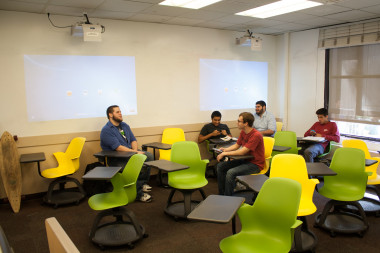

A small group of students sits and talks in a modern classroom with colorful mobile chairs that have built-in desks.
Collection

Learning Assistant Programs

The Learning Assistant (LA) model is a powerful, evidence-informed approach that embeds trained undergraduates into classrooms to support active learning, guide group work, and provide peer mentorship. In this collection are research and guides highlighting improved outcomes and engagement.

Updated May 2025
Katie Johnson headshot
Professor of Mathematics, Chair of the Learning Assistant Alliance
Florida Gulf Coast University
View Bio
01

The Learning Assistant Model

Learning Assistant Alliance

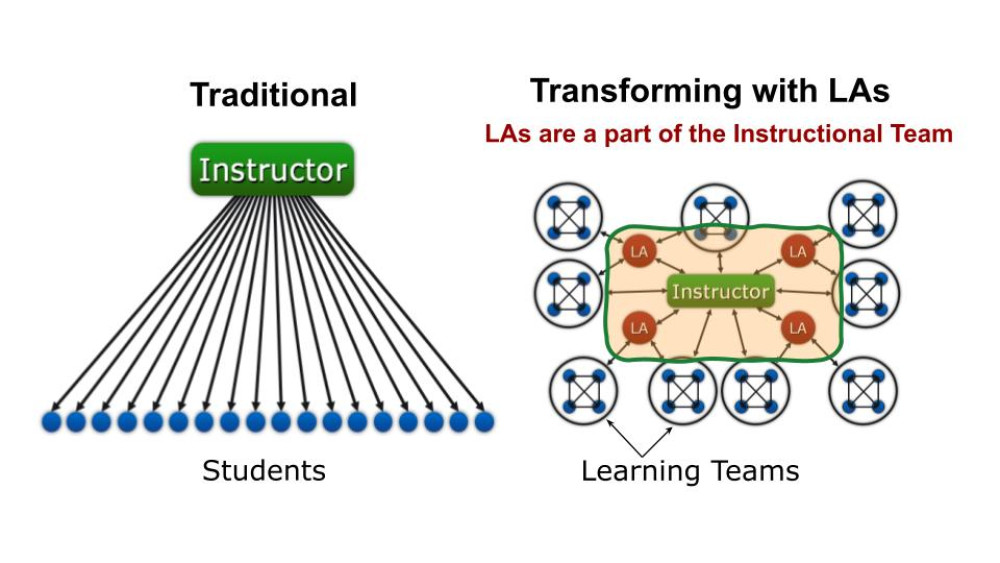
This two-pager from the Learning Assistant Alliance provides a high-level description of the LA model, its essential elements, and its benefits.

Headshot of Katie Johnson
Katie Johnson

Not sure what someone means by "Learning Assistant"? Start here.

View excerpt

The Learning Assistant Model

Learning Assistant Alliance
Open resource

The Essential Elements of the LA Model

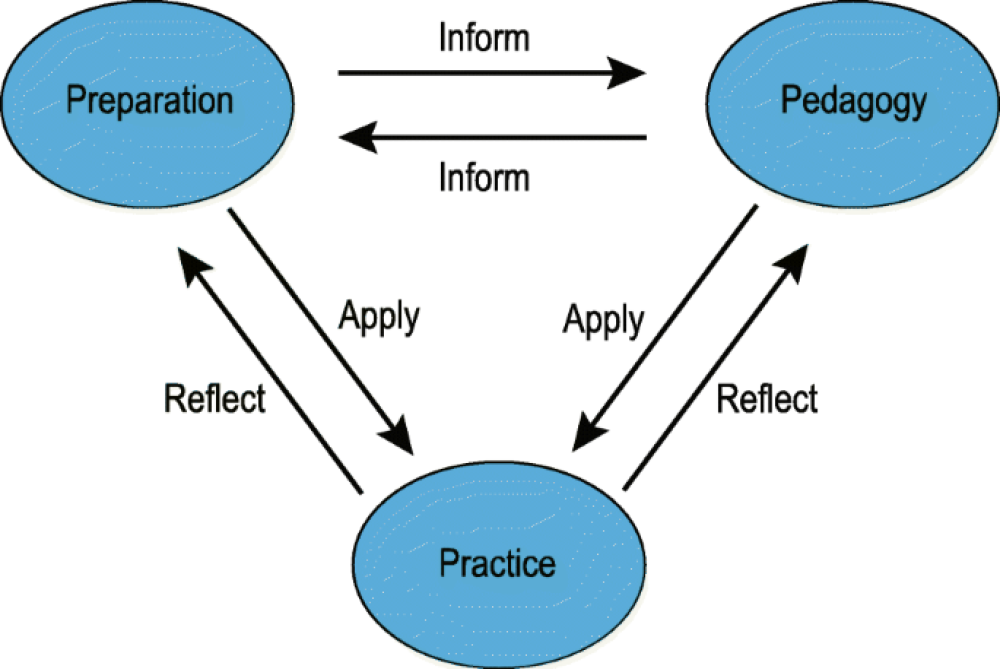
Practice: LAs facilitate discussions and activities in class, focusing on student thinking and understanding.

Preparation: Weekly meetings with instructors to plan classes and discuss student progress. LAs co-design with instructors and help implement class activities.

Pedagogy: LAs enroll in a special pedagogy course to support their development and growth as LAs, learning evidence-based strategies, student-centered and inclusive teaching practices, and practical strategies.

Was this resource helpful?

02

The Best Place to Start Learning about LA Programs

Learning Assistant Alliance

This is a comprehensive resource for faculty and institutions interested in implementing LA programs, offering research, training materials, and community support.

Headshot of Katie Johnson
Katie Johnson

The Learning Assistant Alliance is the go-to hub for everything related to LA programs, from starting a program to accessing training resources and connecting with a national community of educators.

View excerpt

Learning Assistant Alliance

Learning Assistant Alliance
Open resource

Was this resource helpful?
03

The Most Comprehensive Research Article about the LA Model

International Journal of STEM Education

This article highlights research showing that the LA model improves academic outcomes for both LAs and students in LA-supported courses. As the first (and currently, only) comprehensive literature review of the LA model, it offers essential insights for educators and administrators considering its implementation.

Headshot of Katie Johnson
Katie Johnson

This article is my go-to resource when colleagues ask about the research supporting LA programs—it provides a thorough summary of the model’s impacts on students, LAs, and teacher preparation, offers practical recommendations for new programs, and highlights important areas for future research. It's an essential read for anyone implementing or expanding an LA program.

View excerpt

Initially, the implementation of the LA model was developed with four goals in mind (Otero, 2015; Otero, Pollock, & Finkelstein, 2010): (1) transforming undergraduate Science, Technology, Engineering, and Mathematics (STEM) curriculum, (2) recruiting and preparing future STEM teachers, (3) engaging faculty in discipline-based educational research literature, and (4) changing departmental and institutional culture to value evidence-base teaching.

The model was developed and first implemented at the University of Colorado (CU) Boulder campus in 2001 when Drs. Valerie Otero and Dick McCray introduced LAs in the Astrophysical and Planetary Sciences department. Since then, the program has expanded throughout CU Boulder, and other programs have been introduced at institutions around the world (Otero, 2015; Otero, Finkelstein, McCray, & Pollock, 2006). In 2009, an International Learning Assistant Alliance was established, and as of August 10, 2020, it has 2228 members from 456 institutions, 97 of which report having an LA program (Learning Assistant Alliance, 2020). The growth of these programs has stimulated interest in the model as a topic for study, and the founders of the model were recently recognized by the American Physical Society for excellence in physics education (American Physical Society, 2020).

[...]

This review was guided by the goals of the LA model described by Otero et al. (2010) and Otero (2015). We thus ask the question “Does implementation of the LA model improve undergraduate courses and curricula, facilitate teacher recruitment and preparation, encourage faculty to study discipline-based education research, and promote departmental and institutional change?”

Was this resource helpful?
04

A Case Study of How I Helped Build our LA Program

International Journal for the Scholarship of Teaching and Learning

In this article, we share how we built an LA program at a regional university, starting as a grassroots STEM initiative to recruit teachers and expanding into a campus-wide, multi-disciplinary program focused on student success in general education courses. Formative assessments showed LAs positively impacted learning both in and beyond the classroom.

Headshot of Katie Johnson
Katie Johnson

This article is a great resource for understanding how an LA program can adapt to meet institutional needs while positively impacting students, faculty, and LAs. It provides valuable insights into starting and scaling a program, including practical details about developing an effective pedagogy course.

View excerpt

Building a Grassroots Learning Assistant Program

International Journal for the Scholarship of Teaching and Learning
Open resource

To contribute to the broader literature outlining the effectiveness of LA programming, here we a) identify two factors that contributed to the successful initiation of the program, b) describe our implementation and organization of the core aspects of an LA program, c) outline the challenges encountered as we grew the program to serve the broader university, and d) reflect on the ways LAs are used in the classroom and how their use might affect student learning. To formatively assess the LA program following full implementation, we sought to examine the perceived role that LAs play in the classroom through the lens of the students, the faculty partner, and the LAs themselves. This was done to ensure that the role of an LA aligned among the three groups. The results of this analysis are discussed in the context of the LA program during the period of the assessment and the program’s current state.

Was this resource helpful?
05

A Compelling Study on the Effect of LAs on Student Retention and Graduation

Research in Higher Education

This study examines the impact of LA programs on student retention and graduation rates in STEM fields. By analyzing data from institutions that have adopted the LA Model, the authors found that these institutions exhibit higher retention and graduation rates compared to non-adopting institutions. The findings suggest that implementing the LA Model may contribute to reducing inequities in STEM education.

Headshot of Katie Johnson
Katie Johnson

This study provides compelling evidence of the LA model’s role in improving STEM retention and graduation rates. It highlights how institutions with an LA program see higher student success, making it a valuable resource for educators and administrators looking to use peer support to reduce equity gaps in STEM education.

View excerpt

Our findings have several important implications for both policy and practice. Firstly, they highlight the potential of the LA model as a tool for improving student outcomes, particularly in STEM fields. In addition to discovering the overall benefits of having a LA program on campus, we found that the intensity of the LA program adoption in terms of the number of LA courses/programs increasingly benefit students. Moreover, we also discovered more STEM disciplines could potentially benefit from LA program. Right now, the program is concentrated in subjects such as physics, math, biology, and chemistry. Additional adoption in other disciplines such as computer science will boost student success in these courses and majors. All these insights suggest that higher education institutions may benefit from investing in such programs.

Secondly, our study underscores the importance of fidelity in implementing the LA model. LA program directly benefits the students in the courses where LAs are present, as they receive additional support and engagement. The LAs themselves also benefit from the deep learning that comes from teaching others. Furthermore, faculty who work with LAs often report shifts towards more interactive and student-centered teaching practices. Therefore, ongoing recognition and institutional support for the continued implementation of the LA model are essential. Our results indicate that institutions may implement the same program with different fidelity and resulting in different outcomes. To have program implementation fidelity will require active participation from both students and faculty, change in department culture, and institutional financial support. Institutions that wish to adopt this model should ensure they have the necessary support structures in place, such as pedagogical training for LAs and regular preparation sessions.

Was this resource helpful?
06

A Sample of Learning Assistant Programs

Katie Johnson

This site provides a sample of LA programs from across the country who have informative websites.

Headshot of Katie Johnson
Katie Johnson

I created this site as a way to share about different LA programs across the country. They are all a bit different, but each builds on the foundation of the 3 pillars of the LA model (pedagogy, practice, and prep).

View excerpt

Here at BU, the goal of our program is to improve student learning, both that of the LAs themselves, and of the students who are taking the courses with LAs. We also aim to prepare undergraduate students for careers in education, or careers involving educational best practices.

Our philosophy is “Learn to teach; teach to learn.” By learning how to teach, LAs don’t simply master pedagogical skills; they become lifelong learners.

Was this resource helpful?
07

The LA Model from the Instructor and LA Perspectives

Intentional Teaching

In this podcast interview, math professor Katie Johnson and experienced learning assistant Katarya Johnson-Williams discuss the LA model, the impact this kind of program can have on faculty and students, and advice for instructors who are interested in starting up an LA program in their department or on their campus.

Headshot of Katie Johnson
Katie Johnson

Listening to this podcast interview is a great way to be introduced to Learning Assistants! Host Derek Bruff invited me to share about the LA program I founded, and we also feature a student who worked as an LA over several years. It is a wonderful chance to hear the LA's perspective on what the program does for students.

View excerpt

Derek Bruff: I talked with Katie (Johnson) and with Katarya Johnson-Williams, a senior in software engineering with a minor in marketing at Florida Gulf Coast University. We talked about the Learning Assistants model, the impact this kind of program can have on faculty and students, and advice for instructors who are interested in starting up an LA program in their department or on their campus.

Was this resource helpful?

Want to recommend a resource to add to this collection? Send us an email.