
Two women meeting, sitting at a desk, with one writing on paper
Collection

Getting Started with Team Teaching

Teaching with others can enrich student learning and instructor joy, but the challenge of aligning vision and methods may surprise new co-teachers. Use the resources here to support smoother collaborative teaching. Note: we use 'co-teaching' to mean shared teaching responsibilities.

Updated June 2025
Lynn Mandeltort headshot
Assistant Director of Engineering Education Initiatives & Assistant Professor
Office of the Executive Vice President and Provost
View Bio
01

Lynn's Favorite Guide to Team Teaching

CRLT Occasional Papers

This “occasional paper” from Deb Meizlish and Olivia Anderson includes practical advice for collaborative teaching organized into phases of “planning” and “implementation.”

Headshot of Lynn Mandeltort
Lynn Mandeltort

This guide is the most helpful and digestible resource I’ve encountered, especially if you are on the cusp of co-teaching at the college level. I suggest using it as a conversation-starter before you decide to teach together. Then once you’ve begun, use it as a checklist and gut check along your co-instructing journey.

View excerpt

Team teaching can build important personal connections in an instructional community, providing opportunities to mentor new colleagues, lessen isolation in teaching, and build connections across disciplinary silos (Helms et al., 2005). Achieving these positive outcomes, whether for students or instructors, is not guaranteed. Instead, success depends on careful planning and implementation. Without attention to these elements, team-taught courses can create considerable obstacles for students and instructors (Hanusch, Obijiofor, & Volcic, 2009).

... Research indicates that when instructors identify and strategize about challenges during the planning stage, conflict during implementation will be lessened, creating space for a successful team dynamic and providing an effective learning environment for students (Shibley, 2006).
Was this resource helpful?
02

Effective Practices for Team Teaching

Monitor on Psychology

This overview of team teaching describes effective practices with anecdotes from a range of courses.

Headshot of Lynn Mandeltort
Lynn Mandeltort

I like this piece because it includes different team teaching scenarios with the accompanying recommendations. The attention to mutual respect and support is a valuable center of gravity for collaborative teaching teams.

View excerpt

Collaborative instruction, like any team project, can pose its challenges. Sumbleen Ali, PhD, an assistant professor of human ecology at the State University of New York Oneonta, co-teaches a consumer resource management class with two non-psychology professors. While each of the three instructors lends a unique expertise to the course, the team was concerned about student perception as well as potential conflict among themselves based on status.

“We didn’t want factors like a professor’s gender, race, age, and seniority to interfere with student learning, so we made sure we all sat together in class and referenced one another’s lectures in real time,” said Ali. “We all helped each other develop credibility among students through mutual respect.”

This atmosphere of mutual respect allows the team to help each other grow as instructors. Ali’s teaching team meets regularly to discuss how the classes are going (though, to save time, the group never meets synchronously when something can be accomplished via email). They regularly share constructive criticism about lectures and course content, which allows them to both improve their class and learn from one another’s expertise. They believe this approach is helping them all become more well-rounded teachers in the process.

In cross-disciplinary courses, professors may have different views based on their academic background, leading to differences of opinion. This is another reason mutual respect is so important. When Moore teaches with history and philosophy professors, it is not unusual for them to disagree during discussions. “Students sometimes arrive in these cross-disciplinary courses feeling like there’s no room for different ways of thinking,” said Moore. “Watching two professors who have been in their fields a long time disagree shows the students that knowledge is not set in stone, which encourages critical thinking.” Moore recommends working with a colleague you get along with to ensure productive exchanges even amid differing views.

Was this resource helpful?
03

Team Teaching Processes and Outcomes

International Journal of STEM Education

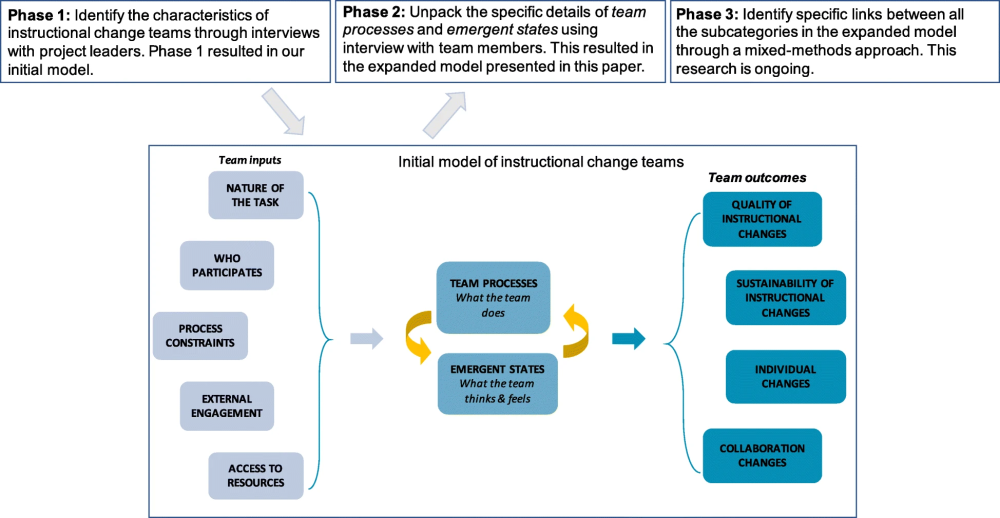
With an eye toward improving instruction, this paper analyzes how team inputs and processes lead to successful outcomes. Instructional collaborators embark on processes (“interdependent acts related to the task”) that influence how they think and feel (“cognitive, motivation, and affective states”).

Headshot of Lynn Mandeltort
Lynn Mandeltort

This research covers important ground toward effective instruction and curricula. Teaching is a team sport that requires communication and cross-course, cross-instructor thinking.

View excerpt

We define clear decision-making processes as the process by which team members discuss and agree on how to go about making decisions relevant to the team and the team’s work. We consider statements that team members agree on how and by whom decisions are made to be evidence of the clarity (or lack of clarity) of decision-making.

In all but one teams, team members described the importance of establishing clear decision-making processes. Some teams explicitly discussed these processes, e.g., establishing that instructors had the ultimate say over the ways that they would implement instructional changes. On other teams, decision-making processes emerged organically and were understood by all the team members. For example, the Material Science and Engineering teams explicitly established that individual instructors had the authority to implement changes in any way they wanted to, while the team would reach a consensus on their major goals and recommendations.

... On the other hand, the Physics team organically established that decision-making would revolve around consensus-building. Eventually, if consensus could not be reached, a final decision would be weighted slightly towards opinions that were supported by education researchers and/or experienced practitioners. Tanya described this process: 'Jack didn’t impose things on people but I would say made decisions based on the person whose opinion he thought was most expert.'

For example, Nick was considered one of the experts in the lecture implementation. Jack would ask Nick what he thought would be best in terms of online homework and various things like that and make decisions.

Was this resource helpful?
04

Power, Perceptions, and Relationships: A Model of Co-Teaching in Higher Education

College Teaching

This research article unpacks important lessons from K-12 co-teaching by interviewing college level co-instructors and pulling salient themes into a helpful framework.

Headshot of Lynn Mandeltort
Lynn Mandeltort

I like this piece because of its intentional connection to the K-12 realm and clear relevance in higher education context. I recommend reading this if you’ve ever wondered about how aspects of co-instruction might influence each other.

View excerpt

Communication that occurred between co-teaching partners was impacted by interactions both in and out of the classroom. Most participants who had successful co-teaching partnerships had relationships that extended beyond the classroom; they were often involved in research together and were sometimes friends beyond work. According to Robert, “If I didn't have a research relationship with somebody, it [a co-teaching relationship] may never evolve.”

Mentoring and co-learning

All of our participants described co-teaching as helping them to grow as instructors, providing them opportunities to reflect on and discuss ideas, perspectives, and approaches that a solo teaching assignment may not offer. Co-teaching helped shape their pedagogical approaches through mentoring or co-learning, supporting the notion in existing literature that co-teaching offers benefits not only to students but also to those involved in the co-teaching relationship.

Was this resource helpful?

Want to recommend a resource to add to this collection? Send us an email.