
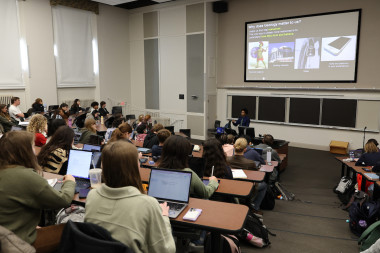

Students in a geology class lecture, sitting in a classroom with stadium style seating and listening to the professor in the background
Collection

What Can Accessibility Mean for My Students?

Accessible teaching involves more than making "reasonable accommodations" requested by individual students with disabilities. Where accommodations are reactive and targeted to individuals, accessibility is proactive and can affect many students. These resources give you a "behind-the-scenes" look at the impacts that accessibility can have on students in real-world ways you might not otherwise understand or recognize.

Updated May 2026
Luke Rosenberger headshot
Associate Director of Digital Accessibility Initiatives
Center for Teaching Excellence
View Bio

Stories of Inclusive Technology

Colorado State University College of Health and Human Services

In this video series, students, faculty and staff with disabilities speak candidly about their own experiences in higher education, and colleagues from disability services and disability studies add their insights. Videos range from general overviews to specific learning needs.

Headshot of Luke Rosenberger
Luke Rosenberger

This series of videos does an excellent job of covering who, what, when, why, and how inclusive technology impacts higher education. Most importantly, the explanations in these videos come from directly from the people who are impacted the most: the faculty, staff, and students who create and use those technologies for teaching and learning. This perspective gives you a unique opportunity to understand how they use technologies for teaching and learning.

View excerpt

Stories of Inclusive Technology

Colorado State University College of Health and Human Services
Open resource

These videos address the growing need to make electronic content inclusive and usable for all users, including students who use assistive technology, students without disabilities who prefer to access content in alternative ways, and instructors who discover that inclusively designed documents are more useful, and easier to build and update.

In each video, speakers tell their stories, helping viewers understand their specific challenges. Students and faculty recount their experiences living with disabilities, using assistive technology, and building inclusive design solutions.

Was this resource helpful?

Stories of Web Users

W3C Web Accessibility Initiative

This resource introduces nine different technology users, each with different disabilities, professions, characteristics and needs. Each user's story includes a video introduction, examples of tech barriers they face, assistive technologies and adaptive strategies they use.

Headshot of Luke Rosenberger
Luke Rosenberger

Everyone uses technology differently to accomplish their goals, and understanding those differences promotes empathy. If you’ve ever wondered how people with different kinds of disabilities use digital technologies, this is a great resource to broaden your understanding.

View excerpt

Stories of Web Users

W3C Web Accessibility Initiative
Open resource

The following user stories represent the experiences of some people with disabilities. They do not address all disabilities or all impacts faced by people with disabilities. These and other disabilities may be present from birth or may develop as a results of an accident, illness, or aging.

  1. Ade, reporter with limited use of his arms
  2. Ian, data entry clerk with autism
  3. Lakshmi, senior accountant who is blind
  4. Lexie, online shopper who cannot distinguish between certain colors (color blindness)
  5. Sophie, basketball fan with Down syndrome
  6. Dhruv, older adult student who is deaf
  7. Marta, marketing assistant who is deaf and blind
  8. Stefan, student with attention deficit hyperactivity disorder and dyslexia, and
  9. Elias, retiree with low vision, hand tremor, and mild short-term memory loss.
Was this resource helpful?

Access Leads to Achievement: A National Report on Disabled College Student Experiences

National Disability Center for Student Success

This report, based on a survey of over 500 postsecondary students across the US and interviews with disabled students, offers deep and sometimes surprising insights into how many college students are affected by disabilities or long-term mental health or chronic health conditions.

Headshot of Luke Rosenberger
Luke Rosenberger

This research study focuses on higher education students who experienced one or more disabilities, chronic health, or mental health conditions for four months or longer – that is, for at least the length of one or more semesters during their college experience. Their hybrid survey and interview approach revealed interesting insights and characteristics about those students’ college lives that are not always evident from other sources of disability statistics. You may be surprised to learn how prevalent and dynamic those situations are, and how students navigate disclosure and privacy around those sensitive situations.

View excerpt

Half of disabled college students in our survey weren’t diagnosed with their disability until college… Disability prevalence is far higher than expected, but many disabled students are not disclosing their disability status to their institutions, instructors, or even — for fully one-third of them — their peers and friends on campus.

Student identities are complex and many resist being described in just one way. Furthermore, the disabled student experience on campus is very different from the non-disabled student experience. Disabled students are less socially engaged, struggle with daily barriers, perceive their campus differently, feel isolated and misunderstood — and some decide to transfer or drop out as a result.

Students repeatedly told us that because of a lack of access and inclusion on campus and in classrooms, their grades suffered, they initiated transfer or withdrawal actions, or they questioned their self-worth and hopes and dreams for the future.

Was this resource helpful?

Students Describe Their Experiences with Hidden Disabilities

University of Southampton Students’ Union

This video presents candid first-person reflections from University of Southampton (UK) students who have invisible disabilities, such as POTS, fibromyalgia, colitis, autism spectrum disorder, anxiety, dyslexia, and PTSD, about their experiences in higher education and society.

Headshot of Luke Rosenberger
Luke Rosenberger

If you were surprised to learn about the prevalence of disabilities, chronic health conditions and mental health conditions from the NDCSS’s Access Leads to Achievement study (recommendation 3 above), take a moment with this video to consider just how many of those conditions can be invisible. Students like these with hidden disabilities face challenging decisions every day between protecting their privacy, disclosing their conditions, and advocating for what they need to level the playing field and achieve their goals.

View excerpt

Hidden Disabilities

University of Southampton Students’ Union
Open resource

“The effort of maintaining a façade is exhausting, so in that respect being a student is quite tricky.” – Ethan, Ph.D. student on the autism spectrum

“I’ve had close friends tell me it doesn’t really seem like it’s a real thing. It does sound unbelievable if someone is in pain 24/7, [but] that doesn’t diminish the fact that people go through it.” – Elin, master’s student with fibromyalgia

“I think it would be really helpful if people stopped deciding that it’s up to them whether or not they think someone is disabled. Just because someone isn’t in a wheelchair doesn’t mean that they’re not allowed to use that facility.” – Ria, 3rd year student with POTS, colitis, anxiety and OCD

“Having people understand me is still something I’m not quite used to, but I feel like slowly, the world’s finally starting to understand what it’s like.” – Charlotte, 3rd year student on the autism spectrum

Video
6 minutes
Was this resource helpful?

Assistive Technology Demonstration Videos

Vision Australia

Vision Australia presents this series of videos in which people who regularly use four different assistive technologies demonstrate how they use specific tools to interact with digital content on the web: a screen reader, a screen magnifier, voice control, and a head pointer.

Headshot of Luke Rosenberger
Luke Rosenberger

There’s no better way to understand the practical impact of digital accessibility than to observe real people as they navigate digital content with the assistive technologies that they use every day. This excellent series of four videos allows you to "look over the shoulders" of people with different kinds of disabilities as they use their technologies of choice and describe the processes they use to work online.

View excerpt

“What is assistive technology?”, “How does it work?”, “How can I make sure my content is accessible for people using assistive technology?”

These are questions we hear often at Digital Access. They are important questions for anyone aiming to design content that is accessible and Inclusive for people with disability.

To help provide some answers, we’re starting a series of informative videos showcasing different assistive technologies. In each video we chat to an assistive technology user to cover:

  • What the assistive technology is
  • A demonstration of how it helps them access content on the web
  • Some common accessibility issues to consider
Was this resource helpful?

What Research Reveals About the “Digital Curb Cut Effect”

PLOS One

Does digital accessibility provide value for learners who don’t identify as disabled, as well as those who do? This 2025 study reveals that accessible content correlates with more sustained cognitive engagement, increased readability, and improved cognitive processing.

Headshot of Luke Rosenberger
Luke Rosenberger

Sidewalk "curb cuts" were originally designed to improve access for wheelchair users, but proved to be useful to many others pushing strollers, pulling luggage, or lugging delivery dollies. The term "curb cut effect" was coined to describe the secondary benefits of accessibility features for a broader population. This study uses a psychophysiological methodology to investigate whether a similar effect applies to digital accessibility features, and whether they can have cognitive benefits for a broader userbase in addition to their essential value for disabled users.

View excerpt

We modified websites on two dimensions: low vision accessibility and cognitive accessibility. Cognitive engagement is an individual’s active involvement in information processing. To measure cognitive engagement, we employ a multimodal data approach providing continuous and objective insights into how people explore websites enhanced with accessibility features. We triangulate self-reports and psychophysiological methods – eye-tracking and heart rate variability metrics – to understand how different accessibility features influence cognitive engagement during website exploration. ...

This study provides compelling evidence that accessibility features, such as cognitive enhancements and low vision adjustments, significantly improve cognitive engagement for all users, not just those with disabilities. Our findings demonstrate that web design practices focused on accessibility can enhance ambient/focal visual attention, sustain cognitive focus, and reduce mental fatigue for everyone, leading to a more inclusive and engaging user experience. By empirically validating these benefits through both subjective and objective measures, the study underscores the universal value of accessible design.

Was this resource helpful?

Building from Empathy to Accessibility

Cornell University Student Disability Services

Cornell SDS’s suggestions for accessible course creation are thoroughly grounded in understanding and empathy with the real experience and needs of students in your courses.

Headshot of Luke Rosenberger
Luke Rosenberger

As you’ve reviewed the six resources above, you’ve expanded your understanding of students' experiences and accessibility needs in your courses. Now, Cornell SDS’s guide is a perfect way to build that awareness into concrete and practical changes you can incorporate into your course planning and design.

View excerpt

Creating an Accessible Course

Cornell University Student Disability Services
Open resource

The best place to start with designing an accessible course is to think of ways to make your course accessible to all types of learners. Universal Design for Learning (UDL) is a framework for designing curriculum in a manner inclusive of all types of learners, regardless of ability, disability, age, gender, cultural background, race, ethnicity, linguistic background, etc. A course that is universally designed will include multiple ways for students to receive information and demonstrate their learning… Invite students, via your syllabus and verbally in class, to meet with you to discuss disability-related accommodations and learning needs.

Was this resource helpful?

Want to recommend a resource to add to this collection? Send us an email.