Open Pedagogy invites students to engage in authorship and curation of open resources, promoting student agency, motivation, collaboration, digital literacy, and open access awareness—allowing students to be creators of knowledge and not just consumers of it.
This essay defines Open Pedagogy, explores its foundations and implications, and offers strategies to apply it in your own teaching.
ES
Bethany Mickel, Emily Scida
This is a truly inspirational piece by Robin DeRosa and Rajiv Jhangiani, internationally known advocates for Open Education, who describe the history of Open Education, its implications for student success, and tools and ideas that you can use to empower learners.
“Open Pedagogy,” as we engage with it, is a site of praxis, a place where theories about learning, teaching, technology, and social justice enter into a conversation with each other and inform the development of educational practices and structures...In this brief introduction, we offer a pathway for engaging with the current conversations around Open Pedagogy, some ideas about its philosophical foundation, investments, and its utility, and some concrete ways that students and teachers—all of us learners—can “open” education. We hope that this chapter will inspire those of us in education to focus our critical and aspirational lenses on larger questions about the ideology embedded within our educational systems and the ways in which pedagogy impacts these systems. At the same time we hope to provide some tools and techniques to those who want to build a more empowering, collaborative, and just architecture for learning.
This chapter describes the benefits that together reinforce the goals of Open Pedagogy: empowering students as learners and creators and building engaging learning experiences for all.
ES
Bethany Mickel, Emily Scida
Students unfamiliar with Open Pedagogy may wonder how and why it might benefit them. This chapter offers a clear, concise explanation to help both faculty and students understand the potential outcomes of engagement in Open Pedagogy assignments.
Another benefit of engaging in open pedagogy is the agency you’ll have over your work in so many different ways. Having agency means having an active role in your learning process often by providing input or feedback to your instructor. Open pedagogy centers your agency so you can make decisions about how you might express your intellectual property rights (something we’ll talk more about in Chapter Six), or the submission format for a project, or how you choose to participate in certain activities.
When you do open pedagogy work, each step of the process builds in opportunities for choice and each step of the process is designed so that you are consistently learning new skills and then building on those skills. This is called scaffolding.
How can faculty enhance student engagement and participation in their courses? Open Pedagogy assignments offer that opportunity by centering learner agency, sharing, collaboration, and community.
ES
Bethany Mickel, Emily Scida
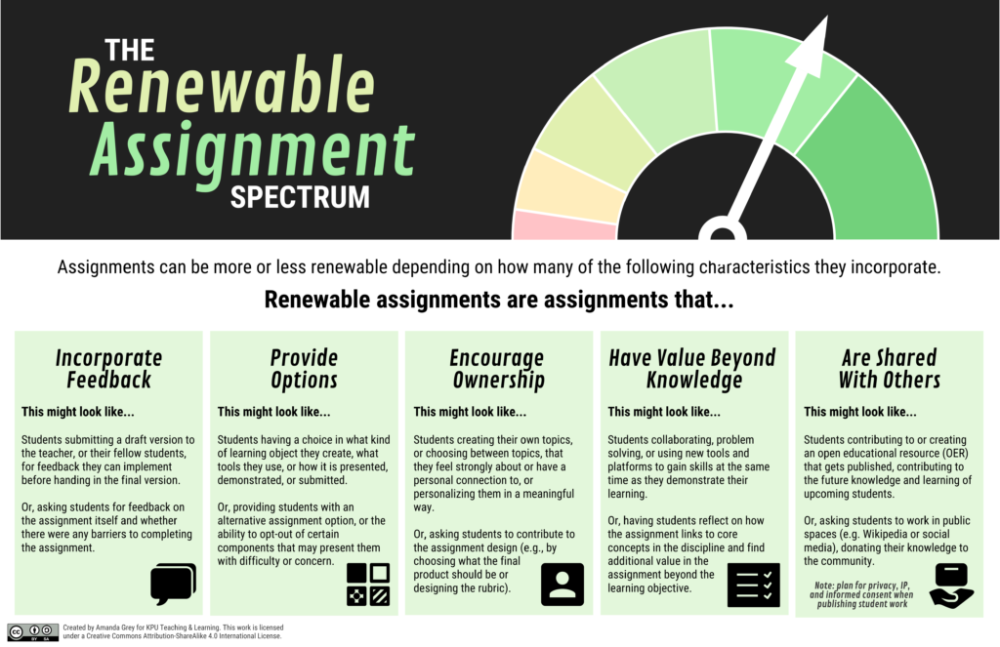
How does an Open Pedagogy (renewable) assignment differ from a traditional (disposable) assignment? This resource offers an easy-to-understand explanation as well as benefits of Open Pedagogy to both faculty and students.
When the open pedagogy principles of collaboration, sharing, and learner agency get applied to assignments, they transform from a disposable, transactional exchange between student and teacher into an invitation from teachers to students to engage in a deeper form of scholarship. They “provide students with opportunities to engage in meaningful work, add value to the world, and provide a foundation for future students to learn from and build upon” (Larson, 2023). The assignment is “designed to be reused and revisited by more than just the student and their instructor” (Capilano University Library, 2022).
This short resource will lead you through essential design decisions as you create an open pedagogy assignment.
ES
Bethany Mickel, Emily Scida
We love this resource, because it offers a concise list of important design decisions for open pedagogy assignments as well as concrete examples for each decision point.
This resource will help you think carefully about the instructional choices, design decisions, and ethical considerations you make as you prepare to engage in open pedagogy with your students.