

active learning in Boston University physics class
Collection

Active Learning

What does active learning look like in practice? How do we design and facilitate experiences that support learning and engagement? This collection brings together resources that explore these questions through research, examples, strategies, and experiences.

For resources focused on teaching in active learning classrooms, see the companion Teaching Hub collection, Teaching in Active Learning Classrooms.
Updated August 2026
Allie Brandriet headshot
Assistant Director
University of Iowa Center for Teaching
View Bio

What is Active Learning? How Do I Design an Activity?

Johns Hopkins University

If you're new to active learning, the third module in this course introduces what active learning is, why it supports student learning, and how instructors can design active learning activities. It may be a useful starting point for those looking for practical guidance.

Headshot of Allie Brandriet
Allie Brandriet

What I appreciate about this resource is that it encourages instructors to think intentionally about how active learning fits within their courses. It explores learning goals, situational factors, common challenges, and ways to create space for active learning, while also inviting instructors to consider why they are using active learning, what they hope students will learn, and how their course context may shape their decisions. In addition, it includes space for reflection and self-evaluation as a way to consider what active learning might look like in your own instructional practice.
Was this resource helpful?

What Does Active Learning Look Like in Practice?

University of Georgia SEER Center

This collection of classroom videos provides real examples of active learning in college science courses, including strategies like group work, polling, and think-pair-share. The videos also include instructors discussing their thinking behind their activity design and teaching decisions.

Headshot of Allie Brandriet
Allie Brandriet

Reading about an active learning strategy and seeing it used in a classroom are often very different experiences. What I appreciate about this resource is that it makes active learning and facilitation strategies more concrete. In addition to showing active learning in practice, several videos include instructor commentary that explains why a particular strategy was chosen and offers insights into how it was facilitated in that context. These examples can help instructors visualize what active learning might look like in their own courses and consider some of the factors that shape activity design and facilitation decisions.

Was this resource helpful?

What Active Learning Strategies Can I Use?

University of Colorado Boulder Arts and Sciences Support of Education through Technology

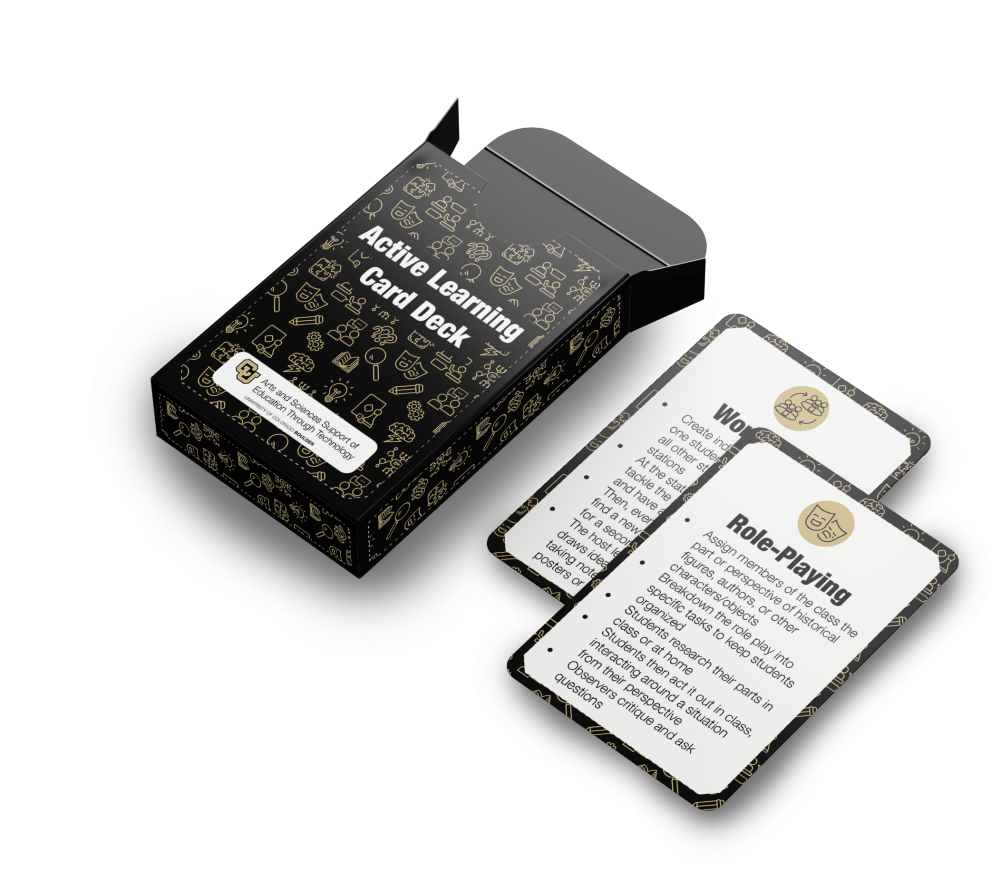
This resource introduces a wide range of active learning strategies for engaging students during class. Each card briefly describes the strategy and how to facilitate it. The cards are available as a PDF, digital collection, and interactive shuffle mode.

Headshot of Allie Brandriet
Allie Brandriet

What I appreciate about this resource is that it provides a practical way to explore a wide variety of active learning strategies. Once instructors have a sense of what knowledge and skills they want students to learn, the card deck can serve as a useful brainstorming tool for thinking through different ways to engage students with course concepts and practice important skills. While these are not the only active learning strategies that exist, this collection offers a great practical starting point for generating ideas and exploring new approaches. (Here's a direct link to the interactive shuffle mode.)

View excerpt

Active Learning Card Deck

University of Colorado Boulder Arts and Sciences Support of Education through Technology
Open resource

What is Active Learning?

Active learning is “anything that involves students in doing things and thinking about the things they are doing” (Bonwell & Eison, 1991). It engages students with the course material through discussions, problem solving, case studies, role plays, and other methods.

About the Active Learning Card Deck

These cards were created by Alexis Block, a graduate assistant in the Arts and Sciences Support of Education Through Technology (ASSETT) department at the University of Colorado, Boulder. They provide 50 active learning strategies to use in your class!

These cards can serve as a resource for your teaching, whether pulling one at random or using them as a reference when planning your course. Note that some cards may involve more preparation than others. If you are a part of the University of Colorado, Boulder community, you can contact us at assett@colorado.edu to inquire about receiving a physical deck from our limited stock of cards! Otherwise, we have these cards available to download as a pdf, as well as an interactive online version hosted on our website homepage!

Was this resource helpful?

How Do I Create Conditions Where Active Learning Can Be Successful?

PhysPort: Supporting Physics Teaching with Research-Based Resources

This resource includes a collection of recommendations for supporting student engagement and participation in learning activities, such as setting expectations, preparing students for active learning, fostering motivation, and building classroom community.

Headshot of Allie Brandriet
Allie Brandriet

Even the most intentional and thoughtfully designed learning activity may not go as planned if students do not understand why they are participating or what is expected of them. This can be especially important in active learning environments, where students may be asked to engage in ways that may feel different from previous learning experiences. As a result, students may need opportunities to understand the purpose of the activity, recognize how it supports their learning, and become willing and motivated participants in the learning process. This resource may be helpful for instructors looking for ideas to help create the conditions that support productive active learning engagement.

Was this resource helpful?

How Do I Create Productive Group Work?

University of Colorado Science Education Initiative

This video introduces strategies for designing and facilitating effective group work in college classrooms. It explores how group work can support learning, offers practical facilitation tips, and addresses common challenges instructors may experience.

Headshot of Allie Brandriet
Allie Brandriet

Group work is a common strategy used in many active learning environments, and it can be challenging to structure and facilitate it in ways that support student learning. What I appreciate about this video resource is its attention to the teaching decisions that shape students' experiences working together. It explores practical considerations such as activity design, group formation, and facilitation, as well as how these choices may influence participation, collaboration, and learning.

Was this resource helpful?

What Evidence Supports Active Learning?

Proceedings of the National Academy of Sciences of the United States of America

Often cited as a landmark meta-analysis in the literature, this open-access article helped elevate conversations about active learning in higher education. While now somewhat dated, it offers important context for understanding active learning's significance in conversations about student learning.

Headshot of Allie Brandriet
Allie Brandriet

I included this article because it is one of the most frequently cited in conversations about active learning. The findings suggest that active learning can positively support student learning and performance in STEM courses, making it a useful resource for understanding some of the evidence behind active learning as a teaching approach. At the same time, I think it is important to interpret the article thoughtfully. Active learning is not inherently better in every context. Like any teaching approach, its impact depends on how it is used, what students are expected to learn, and the specific teaching context. (For one thoughtful response, see Sarah Silverman's 2024 post, "The asterisk to 'active learning.'") With that said, this article provides important context for understanding why active learning remains a significant part of evidence-based conversations about teaching and learning.

View excerpt

Active Learning Increases Student Performance in Science, Engineering, and Mathematics

Proceedings of the National Academy of Sciences of the United States of America
Open resource

Significance

The President’s Council of Advisors on Science and Technology has called for a 33% increase in the number of science, technology, engineering, and mathematics (STEM) bachelor’s degrees completed per year and recommended adoption of empirically validated teaching practices as critical to achieving that goal. The studies analyzed here document that active learning leads to increases in examination performance that would raise average grades by a half a letter, and that failure rates under traditional lecturing increase by 55% over the rates observed under active learning. The analysis supports theory claiming that calls to increase the number of students receiving STEM degrees could be answered, at least in part, by abandoning traditional lecturing in favor of active learning.

Abstract

To test the hypothesis that lecturing maximizes learning and course performance, we metaanalyzed 225 studies that reported data on examination scores or failure rates when comparing student performance in undergraduate science, technology, engineering, and mathematics (STEM) courses under traditional lecturing versus active learning. The effect sizes indicate that on average, student performance on examinations and concept inventories increased by 0.47 SDs under active learning (n = 158 studies), and that the odds ratio for failing was 1.95 under traditional lecturing (n = 67 studies). These results indicate that average examination scores improved by about 6% in active learning sections, and that students in classes with traditional lecturing were 1.5 times more likely to fail than were students in classes with active learning. Heterogeneity analyses indicated that both results hold across the STEM disciplines, that active learning increases scores on concept inventories more than on course examinations, and that active learning appears effective across all class sizes—although the greatest effects are in small (n ≤ 50) classes. Trim and fill analyses and fail-safe n calculations suggest that the results are not due to publication bias. The results also appear robust to variation in the methodological rigor of the included studies, based on the quality of controls over student quality and instructor identity. This is the largest and most comprehensive metaanalysis of undergraduate STEM education published to date. The results raise questions about the continued use of traditional lecturing as a control in research studies, and support active learning as the preferred, empirically validated teaching practice in regular classrooms.

Was this resource helpful?

How Can I Reduce Barriers in My Active Learning Environment?

CBE – Life Sciences Education

This open-access article explores how active learning may create challenges for some students and examines how instructional practices and accommodations can help reduce those barriers. The authors also offer practical recommendations for supporting access, participation, and learning.

Headshot of Allie Brandriet
Allie Brandriet

Active learning can be an effective and engaging instructional approach, but it is also important to consider how students experience the activities we ask them to participate in. I appreciate that this article reminds us that active learning, like any instructional practice, can create unintended barriers to participation and learning. It encourages instructors to think about how course design, facilitation, and accommodations may shape students' experiences in active learning environments. The article also offers practical suggestions for making common active learning situations more accessible for students.

View excerpt

On average, active learning improves student achievement in college science courses, yet may present challenges for students with disabilities. In this essay, we review the history of accommodating students with disabilities in higher education, highlight how active learning may not always be inclusive of college science students with disabilities, and articulate three questions that could guide research as the science community strives to create more inclusive environments for undergraduates with disabilities: 1) To what extent do stakeholders (disability resource center [DRC] directors, instructors, and students) perceive that students with disabilities encounter challenges in active learning? 2) What accommodations, if any, do stakeholders perceive are being provided for students with disabilities in active learning? and 3) What steps can stakeholders take to enhance the experiences of students with disabilities in active learning? To provide an example of how data can be collected to begin to answer these questions, we interviewed 37 DRC directors and reported what challenges they perceive that students with disabilities experience in active learning and the extent to which accommodations are used to alleviate challenges. We conclude the essay with a suite of recommendations to create more inclusive active-learning college science classes for students with disabilities.

Was this resource helpful?

Want to recommend a resource to add to this collection? Send us an email.