
two people talking, one person pointing a finger at the other
Collection

Diffusing Hot Moments in the Classroom

"Hot moments," or moments of conflict, may arise in our classrooms. If we're prepared for these challenging moments and consider all parties with a trauma-informed lens, we can use these moments to enhance, rather than derail our students' learning.

Updated March 2025
Jesse Schneiderman headshot
Faculty Director, Zirkin Center for Excellence in Teaching & Learning & Assistant Professor, Education
Stevenson University
View Bio
Martin Stieglitz headshot
Behavioral Health Supervisor, Penn Integrated Care
University of Pennsylvania Health System
View Bio
01

Navigating Difficult Moments

Harvard University The Derek Bok Center for Teaching and Learning

From Harvard, this link provides some great examples and actionable steps on how to navigate difficult moments in the classroom.


Headshot of Jesse SchneidermanHeadshot of Martin Stieglitz
Jesse Schneiderman, Martin Stieglitz

This link is an excellent resource on providing clear, step-by-step instructions on navigating hot moments as they may arise in the classroom.

View excerpt

Navigating Difficult Moments

Harvard University The Derek Bok Center for Teaching and Learning
Open resource

You make a remark that instigates a strong emotional reaction in a student or group of students. A student offers a comment that marginalizes a range of people and perspectives. Someone is wearing a piece of clothing or taking up space in a way that surfaces ideological disagreement. Now what?

While there’s often no single “right” response, as the instructor, how you address difficult moments in the classroom has implications for learning. Your response can communicate indifference or even hostility; alternatively, it can show that you’re aware of your classroom’s dynamics, you aim to promote learning even through struggle, and you care about your students’ well-being. Here are some tips for helping you to respond productively.
Was this resource helpful?
02

Preparing University Educators for Hot Moments: Theater for Educational Development about Difference, Power, and rivilege

Teaching in Higher Ed

This article addresses multiple issues that may occur while dealing with hot moments in the classroom and how to mitigate them.

Headshot of Jesse SchneidermanHeadshot of Martin Stieglitz
Jesse Schneiderman, Martin Stieglitz

This article is especially valuable in how it discusses power and privilege, both in the classroom among students and the power dynamic that may exist between a faculty member and students.

View excerpt

A ‘hot moment’ is an emotion-laden moment of conflict or tension that threatens to derail teaching and learning. In this study, an educational development workshop used interactive theater depicting a hot moment to prepare university instructors for diverse classrooms. Participants in three workshops wrote short reflections, both before and after the theater-based experience, about whether instructors should consider differences among students. After the workshop, many participants took new dimensions of difference into consideration. Surprisingly, after the interactive theater experience, almost all participants reflected exclusively on instrumental issues in teaching (e.g. classroom management strategies), but not structural issues of difference, power, and privilege that underlie hot moments. The empirical findings and the author's reflections on a personal hot moment are theorized in terms of concepts from and critiques of critical and feminist pedagogy.

Was this resource helpful?
03

Addressing High-Level Interruptions

ACUE

This resource provides simple steps for handling high-level interruptions during a classroom conversation.

Headshot of Jesse SchneidermanHeadshot of Martin Stieglitz
Jesse Schneiderman, Martin Stieglitz

As another step-by-step guide to handling hot moments in the classroom, this provides guidance for faculty on handling these high-level interruptions both safely and appropriately.

View excerpt

It is important to deal with incivilities promptly and consistently. If the problem is ongoing or particularly egregious, or if you are concerned about the student’s response, schedule a follow-up conference with the student during office hours to address the behavior. Using the following structure for a conference can help make it more effective.

Was this resource helpful?
04

Successful Classroom Discussions Begin Long Before Anyone Speaks

Times Higher Education

Classroom discussions help engagement and learning, but students don't always walk in our classrooms knowing how to participate well in discussions. We can teach this through careful scaffolding.

Headshot of Jesse SchneidermanHeadshot of Martin Stieglitz
Jesse Schneiderman, Martin Stieglitz

The idea that laying the groundwork for creating positive classroom discussions is often something we miss in the grander scheme of worrying about these hot moments. This piece appropriately addresses that.

View excerpt

For many students, speaking up in class was never easy, and it seems even harder after learning in isolation or via screens for many terms. Add to that the pressures of a hyper-polarised political climate, where students and faculty fear censure and tread lightly to avoid offending others, and the result is an environment in which facilitating classroom discussion can feel like pulling teeth.

While classroom discussions have never been easy, they seem especially important for students’ academic learning and social development following the pandemic lockdowns. Since the 1970s, research has accumulated showing that engaging people in classroom discussions about important issues grows their critical thinking and communication skills, civic knowledge and interest, comfort with conflict, and commitment to democratic values such as tolerance, diversity and equality. Such discussions don’t undermine or take away from content teaching but enhance it, studies show, by placing it in broader contexts and demanding that students make meaning out of what they have learned.

Was this resource helpful?
05

Common Beliefs

Teaching Tolerance

When navigating hot moments, we need to make sure we avoid statements that show implicit bias. Evaluating our own implicit biases and knowing them in advance is key.

Headshot of Jesse SchneidermanHeadshot of Martin Stieglitz
Jesse Schneiderman, Martin Stieglitz

Analyzing and addressing your own bias first is the key to having good conversations in the classroom. I love this resource because of how it presents potential biases we may have.

View excerpt

Common Beliefs

Teaching Tolerance
Open resource

COMMON BELIEF 1

I don’t think of my students in terms of their race or ethnicity. I am color blind when it comes to my teaching.

Background

When teachers say they are color blind, they are usually saying that they do not discriminate and that they treat all their students equally. Of course, being fair and treating each student with respect are essential to effective teaching. However, race and ethnicity often play important roles on children’s identities, and contribute to their culture, their behavior, and their beliefs. When race and ethnicity are ignored, teachers miss opportunities to help students connect with what is being taught. Recognizing that a student’s race and ethnicity influences their learning allows teachers to be responsive to individual differences. In some cases, ignoring a student’s race and ethnicity may undermine a teacher’s ability to understand student behavior and student confidence in doing well in a school culture where expectations and communication are unfamiliar. An individual’s race and ethnicity are central to her or his sense of self but they are not the whole of personal identity. Moreover, how important an individual’s race and ethnicity is to their identity will vary and teachers need to take that into account as they seek to learn more about their students.

Was this resource helpful?
06

What Is a Trauma Informed Classroom? What Are the Benefits and Challenges Involved?

Frontiers in Education

This paper investigates the elements of a “trauma informed classroom.” Being trauma-informed in your approach is key to reducing hot moments in the classroom.

Headshot of Jesse SchneidermanHeadshot of Martin Stieglitz
Jesse Schneiderman, Martin Stieglitz

The explicit inclusion of student voice and the implication of the emotional safety needed to have deep conversations with students are the resounding parts of this article.

View excerpt

The foundation of the “trauma informed classroom” is an understanding by teachers of the daily circumstances of their pupils’ lives, and awareness of what trauma-based reactions and behaviours look like. The rituals and teaching methods of the classroom may be modified in response to the pupils’ needs, in consultation with them, and in a system of ongoing feedback. This work necessitates a collaborative team to support the teacher, and access relevant services. The aim of this paper is to explore the elements of a trauma informed classroom. The benefits and challenges for pupils and teachers will also be discussed.

Was this resource helpful?
07

Facilitating Contentious Conversations in Your Classroom

Teaching in Higher Ed

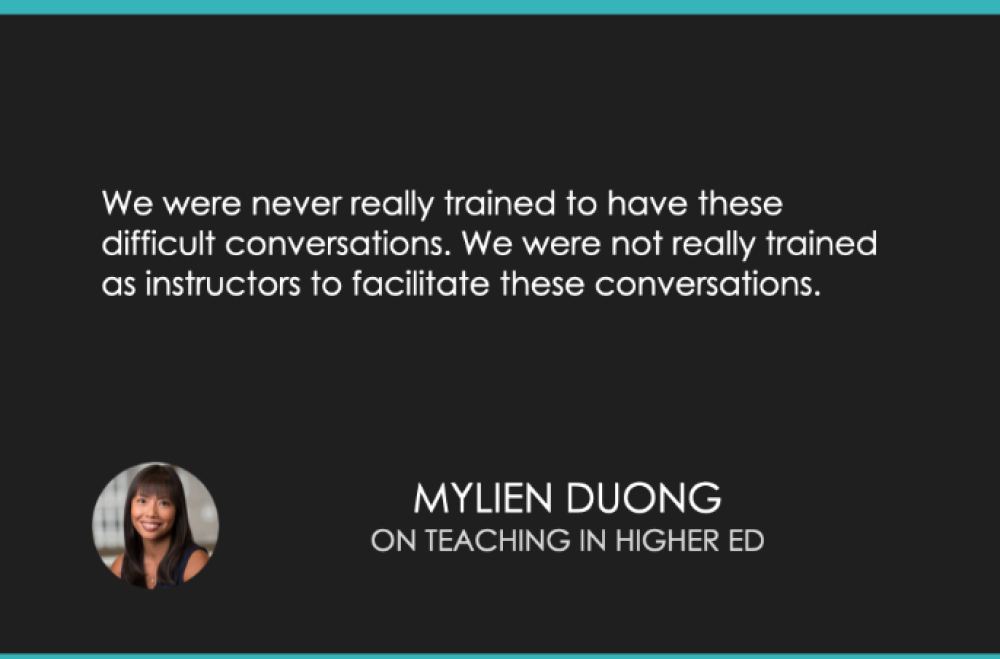
In this podcast interview, Mylien Duong, Senior Director of Research at the Constructive Dialogue Institute, discusses strategies for facilitating contentious conversations in your classroom.

Headshot of Jesse SchneidermanHeadshot of Martin Stieglitz
Jesse Schneiderman, Martin Stieglitz

We love this episode of Teaching in Higher Ed with Bonni Stachowiak! It's an excellent resource.

View excerpt
Was this resource helpful?

Want to recommend a resource to add to this collection? Send us an email.