
Barre's Taxonomy of Learning Goals
When this resource was first sent to me via Liz Norell from Josh Eyler, I was enthralled. With the focus on developing students more broadly, not just conveying and scaffolding information, I found this approach to be much more student-centered than most taxonomies. I have found it particularly useful with faculty who co-create aspects of their courses with students in structuring the experiences.
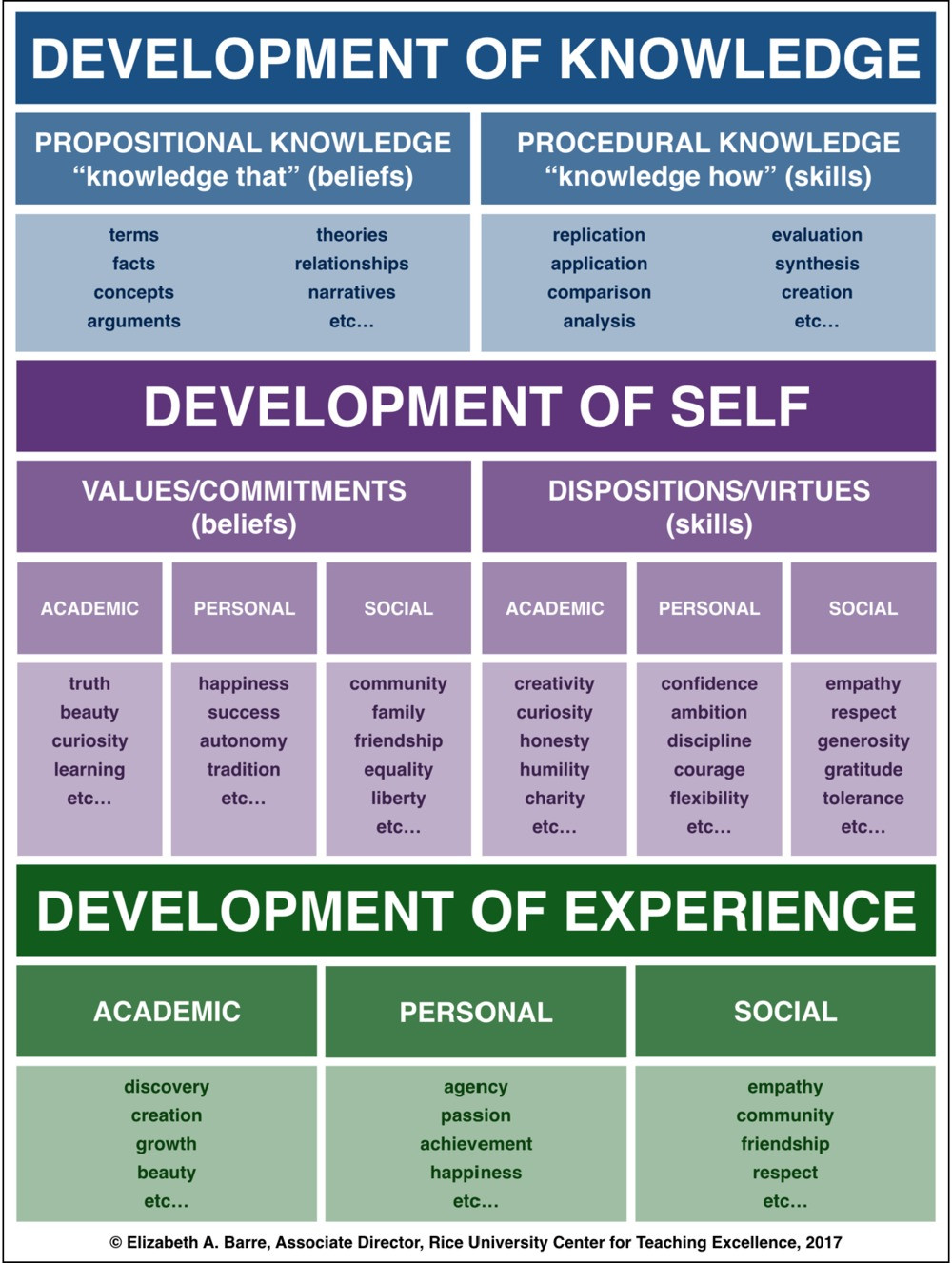
Helping faculty think through what they value in the context of their courses is my favorite part of course design. But I have to confess that the traditional taxonomies I use when doing so have never made much conceptual sense to me. So after many years of introducing these categories with the caveat that we shouldn't think too hard about them, I finally decided to create my own. I didn't think the world needed yet another taxonomy of learning goals, but I thought I would do a better job talking with faculty if I could present the alternatives in my own vernacular. And it turns out they liked it enough to insist that I share.
When I sat down to do this, I began with a basic assumption: that teaching is many things but, at its core, it is ultimately about helping our students to develop in various ways. A focus on development makes my taxonomy a bit broader than those that emphasize learning, but that is intentional. When most of us think of the word "learning," we think of a very narrow range of activities and outcomes. But we often hope to achieve many other things when we teach, and a focus on development can give us room to be more intentional about folding those goals into our course planning. More specifically, my taxonomy helps us to think about our teaching in terms of three broad developmental goals: the development of knowledge, the development of self, and the development of experiences.