
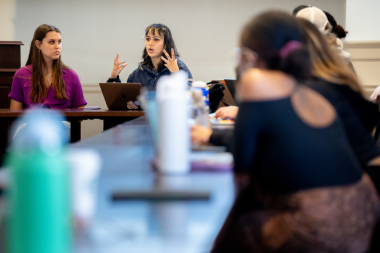

UVA students participating in discussion
Collection

Dialogue & Deliberation Across Differences

The ability to have productive and respectful discourse with folks holding different values, identities, and opinions is critical for a functioning democracy, but challenging to foster. This collection supports instructors preparing students to engage across differences. 

Updated January 2026
Bethany N. Morrison headshot
Assistant Director
Center for Research on Learning and Teaching, University of Michigan
View Bio
01

Promoting Democracy: Fostering Skills for Better Civil Discourse

University of Michigan Center for Research on Learning and Teaching

This article from the University of Michigan's Center for Research on Learning and Teaching makes the case for the importance of preparing students for productive conversations across differences and disagreements. It also provides principles and strategies for putting that into practice.

Headshot of Bethany N. Morrison
Bethany N. Morrison

I wrote this piece following an act of political violence that both shook higher education and contributed to the growing call to prepare our students for productive conversations across disagreement. I want to share the piece at the start of this collection for a couple of reasons: first, it motivates dialogue & deliberation as skills for a functioning democracy. Second, it underscores a key prerequisite: that we “lay a foundation of instructor care and classroom community before we ask students to take on this challenging, sometimes vulnerable work.” 

View excerpt

Promoting Democracy: Fostering Skills for Better Civil Discourse

University of Michigan Center for Research on Learning and Teaching
Open resource

Last October 31st, five days before the 2024 election, I took my kids trick-or-treating in our neighborhood. Among the eight-foot skeletons and pumpkins in Detroit Lions gear, many houses sported yard signs supporting candidates for the U.S. presidency. My children knew who I’d vote for that Tuesday, so maybe I shouldn’t have been surprised when these guileless six-year-olds booed—actually booed—a yard sign for the other candidate on their way to ask the sign-owner for treats.

It was there, in the shadow of a contentious election with a crew of cute, filterless superheroes, I thought of John Dewey’s reminder that “democracy needs to be born anew every generation.” Education, he argued, is how we cultivate it. At the University of Michigan, the role of “developing leaders and citizens who will challenge the present and enrich the future” is at the forefront of our mission. It also guides CRLT and the Edward Ginsberg Center in our Promoting Democracy Teaching Series collaboration.

Was this resource helpful?
02

When Dialogue Hurts—and Heals

When We Disagree Podcast

In this episode of the When We Disagree podcast, Professor Michael Lee talks with UVA’s Rachel Wahl about her interviews with college students after a one-on-one dialogue session with a peer who disagreed with them. She focuses on a particular interview that “reveal(s) both the promise and heartbreak of real engagement.”

Headshot of Bethany N. Morrison
Bethany N. Morrison

Michael Lee starts each of this podcast’s short episodes by asking the guest to tell us “an argument story.” Sometimes the conversation moves on quickly, but I love it when the argument story ends up as the heart of the episode. The story Rachel Wahl shares in this episode is about a dialogue session between a queer student and a conservative evangelical student. The story is an important reminder of what exactly we are asking of students when we ask them to dialogue across meaningful differences and the lasting impact these conversations can have.

Was this resource helpful?
03

Constructive Dialogue Institute's Listening Sessions Activity

Constructive Dialogue Institute

The Constructive Dialogue Institute is a non-profit organization that creates educational resources for communicating across differences in response to growing political polarization, including its online student program Perspectives, instructor webinars, and classroom activity guides, one of which I share here.

Headshot of Bethany N. Morrison
Bethany N. Morrison

If you’ve read a Chronicle of Higher Ed piece about civil discourse or dialogue across differences in the last two years—whether the tone is positive or critical—they likely mentioned the Constructive Dialogue Institute. Universities across the country are adopting CDI’s Perspectives online into their first-year student orientations (and educators can sign-up to explore this program at no-cost). I’m highlighting a guide here for a short classroom activity that builds a key component skill of dialogue: listening to understand, setting aside our impulses to evaluate, respond, or compare to ourselves. 

Was this resource helpful?
04

Recognizing Power Imbalances in Decision-Making: Activity Guide

Collaborative Discussion Project

This classroom activity guide by Janice McMillan and the Collaborative Discussion Project includes step-by-step instructions, a diverse set of real-world scenarios, and thoughtful reflection questions that encourage students to pay attention to deep-rooted power imbalances in dialogue and deliberation.

Headshot of Bethany N. Morrison
Bethany N. Morrison

Within the growing discussion in higher education about creating programs for dialogue and deliberation across differences, folks have raised a critical concern: approaches that do not account for imbalances in power can contribute to systems of inequity. While my first inclination was to recommend a piece that outlines this point (e.g. “Civility is Insufficient” by PACE), I’m sharing instead one particular classroom activity designed for students to recognize the impact of power imbalances. It also gives me an opportunity to draw your attention to the larger Collaborative Discussion Project and its “toolkit” of class activities.

Was this resource helpful?
05

Ways to Get Students Talking Across Differences: Advice From Two Faculty Innovators

University of Michigan Center for Research on Learning and Teaching

This article from the University of Michigan's teaching center shares how two U-M faculty members developed innovative learning experiences to guide students as they develop skills for productive and respectful discussion across differences. 

Headshot of Bethany N. Morrison
Bethany N. Morrison

When I ask students to engage in a classroom discussion on a high-stakes topic, I worry about the possibility of heated, perhaps even disrespectful, arguments. In my experience, however, the more common challenge is getting students to voice a disagreement at all. The risks of social and academic censure may seem too high. This piece highlights two instructors who come at this challenge from different angles: Rebecca Scharbach Wollenberg’s Pluralism Workbook uses short written reflections, where students can surface their fears and what might be gained from a difficult discussion, along with practicing skills and developing language to use in a difficult discussion. Alternatively, Sara Ahbel-Rappe illustrates how an extended role-play can encourage perspective-taking and provide students with some distance from their own deeply held positions.  

View excerpt

Our last blog post explored productive engagement across diverse viewpoints, values, and backgrounds, essential skills of democratic citizenship. In this post, we continue that theme by highlighting two projects, each of which was designed to teach students to talk across differences of worldview. Professor Rebecca Scharbach Wollenberg developed a set of exercises to promote open inquiry which can be incorporated into courses in a range of disciplines. Students in Professor Sara Ahbel-Rappe’s course take on roles of historical figures and create podcasts in character to develop skills at listening and responding to differences of viewpoint. Both were recognized last year with Provost’s Teaching Innovation Prizes (TIP). (FYI, The 2026 TIP competition is accepting nominations and self-nominations through January 30th.) Below, you will find descriptions of each project, including brief video comments by Professors Scharbach Wollenberg and Ahbel-Rappe along with some suggestions for adopting these approaches.

The first winning teaching innovation that we’re highlighting is a tool developed by Professor Rebecca Scharbach Wollenberg (Judaic Studies). She was looking for a solution to a problem that many instructors are facing in the current environment. Students are quite reluctant to engage across differences in outlook and opinion. Instead, they try to suss out the professor’s expectations and parrot them back, which feels much safer and more comfortable than risking disagreement or even censure from classmates and the instructor. She is careful to point out the social reasons for this phenomenon and how it differs from faculty experience...

Was this resource helpful?
06

Listening and Asking Good Questions

When We Disagree Podcast

In this episode of the When We Disagree podcast, Professor Michael Lee interviews Martin Carcasson, the director of the Center for Public Deliberation at Colorado State University, about the differences (and similarities) between dialogue, deliberation and debate.

Headshot of Bethany N. Morrison
Bethany N. Morrison

This collection is about dialogue AND deliberation across differences, so while they share component skills, I want to dedicate attention to deliberation in these last two resources. In this short episode of the When We Disagree podcast, Martin Carcasson thoughtfully lays out the Venn diagram of dialogue, deliberation, and debate. This is its principal contribution to the collection. That said, the piece also stuck with me because it convinced me to reconsider the potential of debate—and I didn’t think I was open to that. 

Was this resource helpful?
07

Adding Deliberation to a Dance Course on Critical Writing

Deliberative Citizenship Initiative

The Deliberation Across the Curriculum program supports faculty incorporating deliberation around important, sometimes divisive issues into their courses—from STEM to the Arts. In this piece, Kathleen Wessel reflects on the semester she integrated deliberation into Critical Writing for Dance.

Headshot of Bethany N. Morrison
Bethany N. Morrison

This blog series is written by faculty in a community dedicated to integrating deliberation into their coursework. I value the authors’ retrospective narratives on the whole semester of their deliberation redesign, including their initial intentions and assumptions, early failures, and what ultimately proved most impactful. I’m linking to one just piece in the series in this collection—not only does Kathleen Wessel exemplify the story-telling I find so helpful, I’m excited to highlight an example from the arts to bring home how instructors across the academy prepare our students to participate in a diverse democracy where folks will hold differing values, identities, and opinions. 

View excerpt

Last spring, I took my Critical Writing for Dance students to see Alvin Ailey American Dance Theater perform at the Fox Theatre in Atlanta. They were tasked with writing a critical analysis of at least one of the works on the triple bill and all arrived with their notepads and pens in hand. After the first work, they sat in a row (dressed to the nines!) and scribbled out thoughts and first impressions as I had suggested. A nearby audience member, curious to see ten Spelman women furiously writing at the same time, asked what they were doing. One of my students answered, and the audience member responded: “Why? It’s not that deep.”

As the sole faculty member representing the arts in the 2023-24 Deliberative Pedagogy (DeeP) Collaborative cohort, I can attest: it is that deep. But both those who study dance and those who teach it in higher education often feel we must prove ourselves, and that burden can be exhausting. Identifying “wicked problems” and controversial topics to deliberate in a Peace and Conflict Studies or a Philosophy class seems like par for the course. Dance is trickier because it tends to be characterized in popular culture as either individual expression / catharsis or pure entertainment, neither of which – on the surface at least – affords much need for deliberation or critical analysis. And people can get defensive when scholarship, texts, research, and writing are introduced into sacred, emotionally charged movement spaces. Let’s not overthink it, I hear, dance is just about releasing and having fun.

Was this resource helpful?

Want to recommend a resource to add to this collection? Send us an email.