
Screenshot of a visual syllabus
Collection

Unconventional Syllabi

Can a syllabus do more than convey policies and schedules? This collection includes our favorite examples of syllabi that embrace creative, fun, or otherwise unconventional interpretations of the syllabus genre while still fulfilling the basic roles of syllabi. It ends with advice and commentary about adding visual (and other) elements to your syllabus.

Updated May 2026
Lynn Mandeltort headshot
Assistant Director of Engineering Education Initiatives & Assistant Professor
Office of the Executive Vice President and Provost
View Bio
Derek Bruff headshot
Associate Director
Center for Teaching Excellence
View Bio

A Themed Syllabus: Stranger Things Meets Financial Accounting

Teresa Thompson

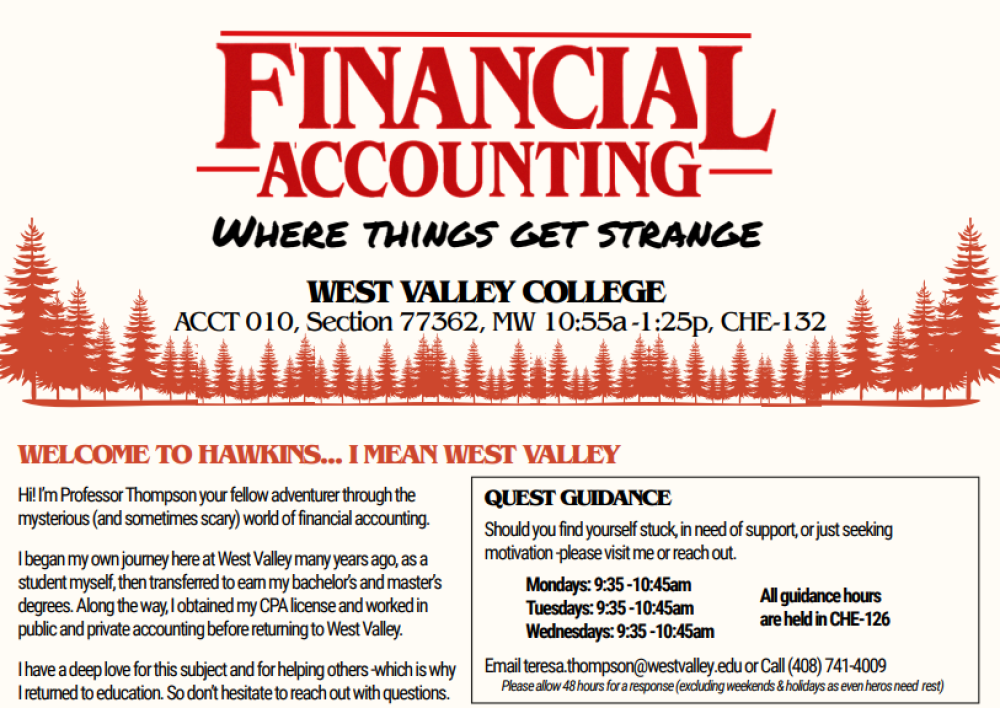
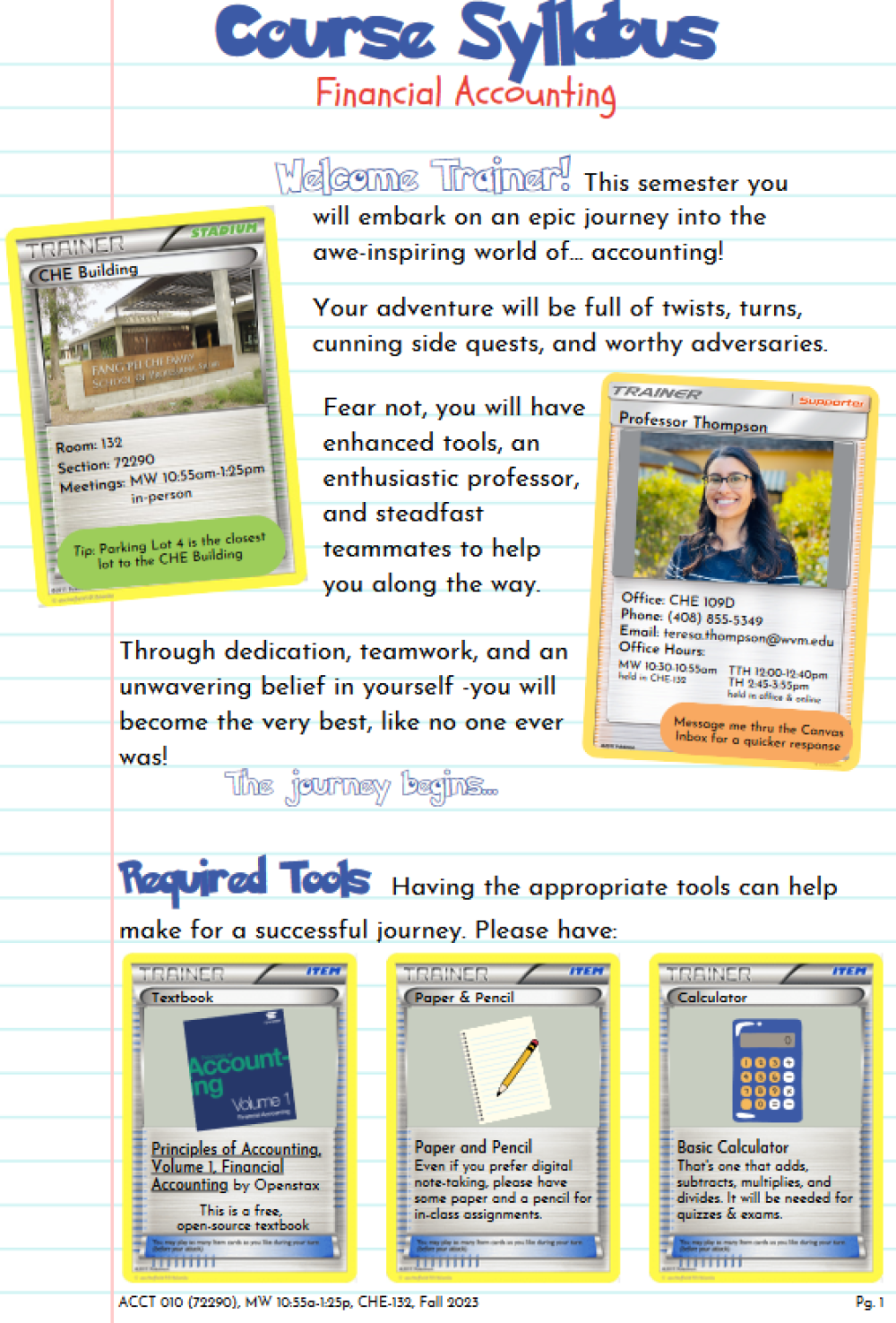
Teresa Thompson teaches accounting at West Valley College in California. She likes to theme her syllabi using pop culture and this one for her financial accounting course is themed around the television show Stranger Things.


Headshot of Lynn MandeltortHeadshot of Derek Bruff
Lynn Mandeltort, Derek Bruff

We appreciate how Thompson makes a subject like financial accounting—which might strike some as dry—more engaging through the use of a Stranger Things theme. Note her effective use of fonts, as well as the way she taps into the Dungeons & Dragons elements of the Stranger Things show. Fun photos of the instructional team round out an engaging syllabus.

View excerpt

THE MISSION

This quest is not for the faint of heart. Along the way, you’ll battle challenging problems, decode financial puzzles, and work side-by-side with your Party to ensure everyone makes it out of the Upside Down safely. Your courage, curiosity, and collaboration will be the keys to victory.

Upon successful completion of this semester-long quest, you will be able to:

  • Apply transactional analysis, input transactions into the accounting system, process this input, for a corporation engaged in service and/or merchandising operations.
  • Explain the nature and purpose of IFRS, Long-Term Liabilities, Stockholder's Equity and Reporting Requirements, Statement of Cash Flows, & financial statement analysis.
  • Explain the content, form, and purpose of the basic financial statements (including footnotes) and how they satisfy the information needs of investors, creditors, and other users.
Was this resource helpful?

A Papercraft Syllabus as Roadmap for the Futures of Design Pedagogy

Emily Wettstein

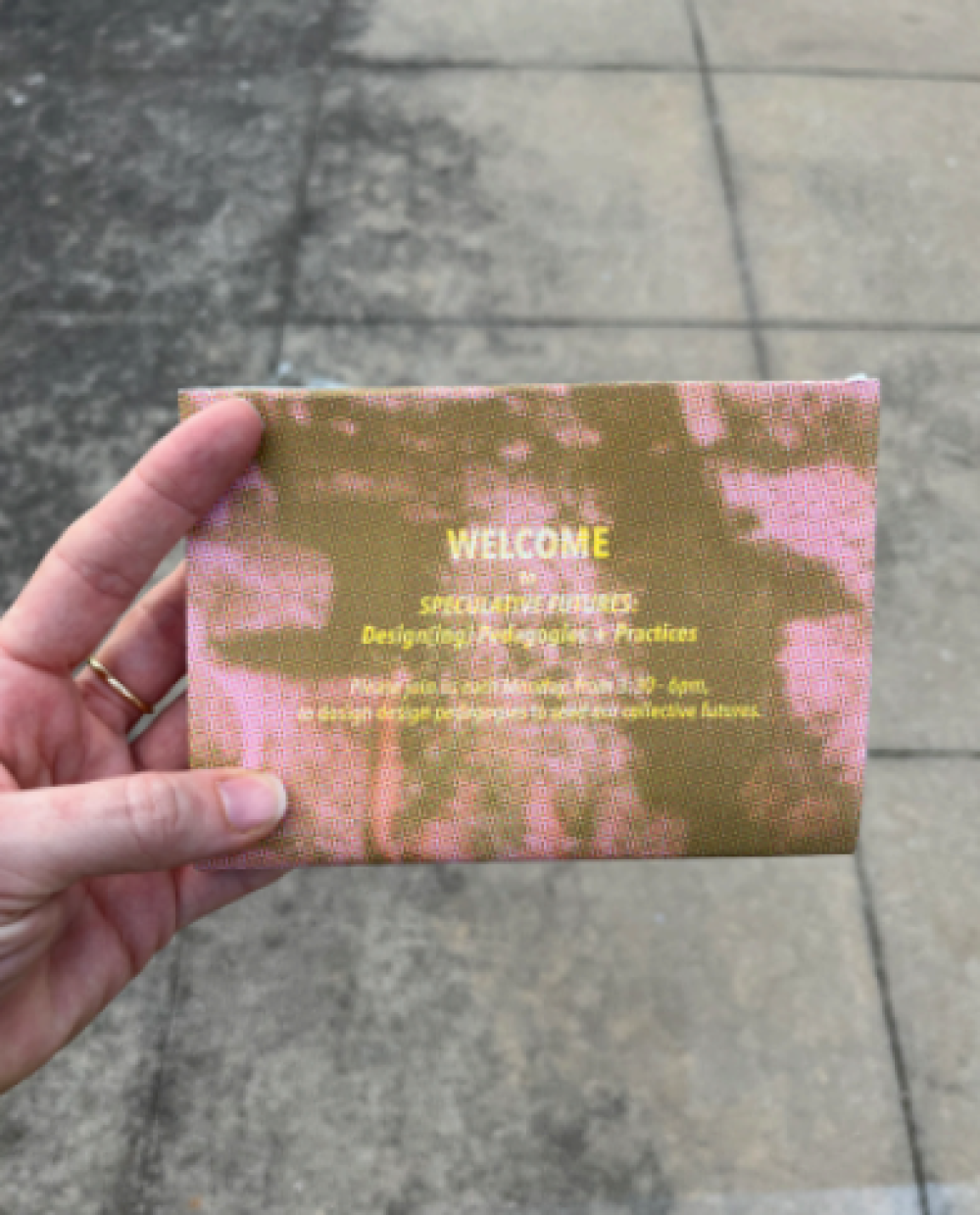
Emily Wettstein is an assistant professor of landscape architecture at UVA. She teaches a course called "Speculative Futures: Design Pedagogies + Practices" for which the syllabus is a folded, hands-on journey that echoes the course’s creative design elements.

Headshot of Lynn MandeltortHeadshot of Derek Bruff
Lynn Mandeltort, Derek Bruff

If you’re wondering how the syllabus genre can be enlivened, check out this printed mini booklet that serves as a folded and highly visual overview of course info and a physical manifestation of a course philosophy. We love how the course learning objectives are imbued in the design of the object itself. The syllabus, as an artifact of a course, can convey more than course info; it carries tone, imagination, an aesthetic, and when done well, can represent—using more than words—something about the kinds of learning students will do in your course.

View excerpt
Was this resource helpful?

A Multimedia Course Website as a Digital Humanities Syllabus

Brian Croxall

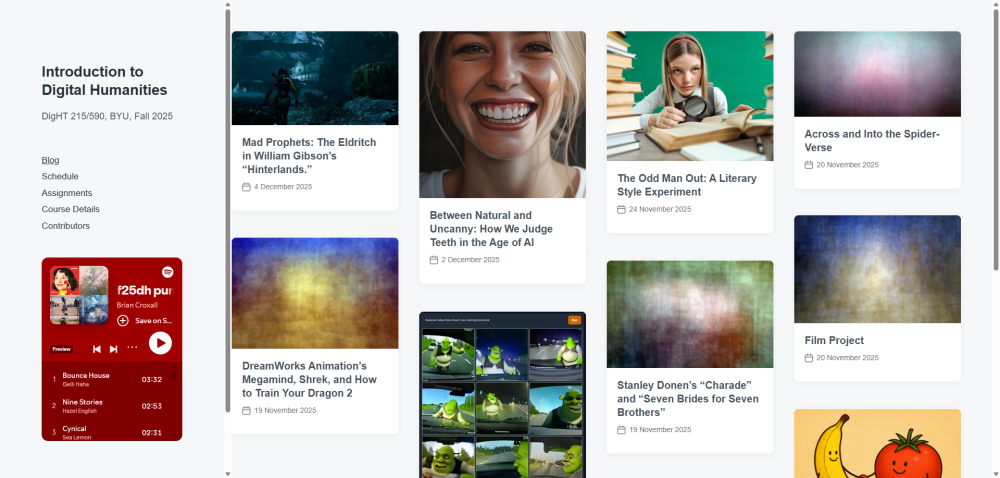
Brian Croxall teaches digital humanities at Brigham Young University. His syllabus is actually a course website, and the landing page is a multimedia experience, with a playlist in the sidebar and Pinterest-like links to student work. The menu takes you to traditional course details, where you can also find a PDF version of the syllabus.

Headshot of Lynn MandeltortHeadshot of Derek Bruff
Lynn Mandeltort, Derek Bruff

This is just one of many web-first course websites created and archived by digital humanist Brian Croxall (see briancroxall.net). The designs are aesthetically clean and easy to navigate while still giving the course a visual—and aural—personality. Did we listen to his course's Spotify hype playlist while writing this? Absolutely.

View excerpt
Website
2-3 minutes
Was this resource helpful?

A Liquid Syllabus for an Online Photography Course

Michelle Pacansky-Brock

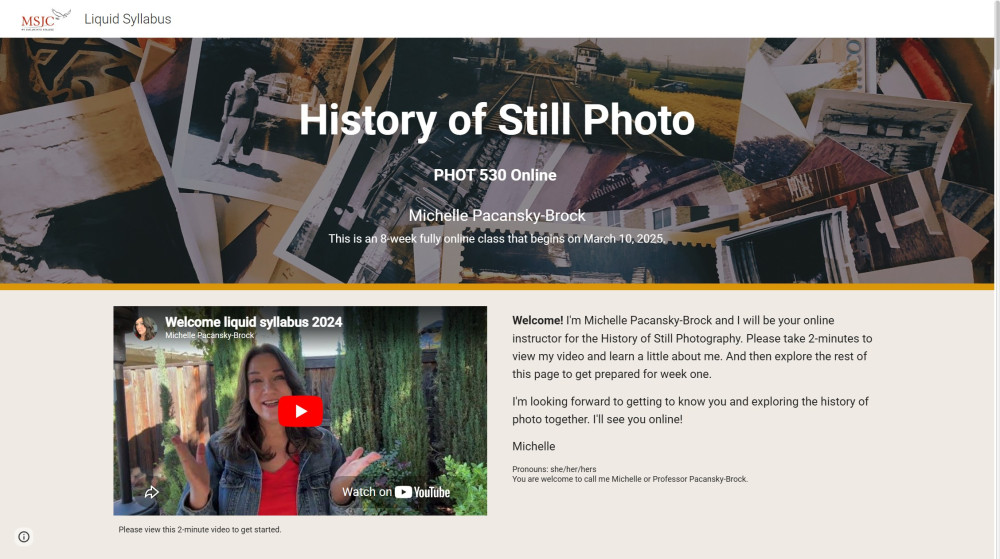
Michelle Pacansky-Brock is an innovative educator and faculty developer—and an advocate of what she calls the "liquid syllabus," a student-friendly public website that helps to humanize online courses. Here's an example from a course on the history of photography she taught for many years.

Headshot of Lynn MandeltortHeadshot of Derek Bruff
Lynn Mandeltort, Derek Bruff

Note the warm, informal welcome video from Michelle, as well as the mix of text and videos onboarding students to her course. Michelle recommends making a liquid syllabus like this available to online students as soon as possible—even before they get LMS access for the course. It's a mobile-friendly site that orients students toward success from the very start.

For more on liquid syllabi, see Michelle's short course on the topic.

View excerpt

History of Still Photo

Michelle Pacansky-Brock
Open resource

My Teaching Philosophy

I believe everyone is capable of learning and the differences each person brings into a class enrich the learning of the group. Each person learns at a unique rhythm, which is precisely why I love online classes! Unlike a live classroom, asynchronous online environments, like ours, provide you with the luxury of thinking and reflecting before you engage. They create a seat at the table for everyone. They also enable us to use the world as our classroom. I design my courses to showcase and celebrate the diversity of the members of our learning community and to encourage each of student to connect our course content to their own life.  

Was this resource helpful?

Comics as Syllabus for a Course on Superheroes

Nick Sousanis

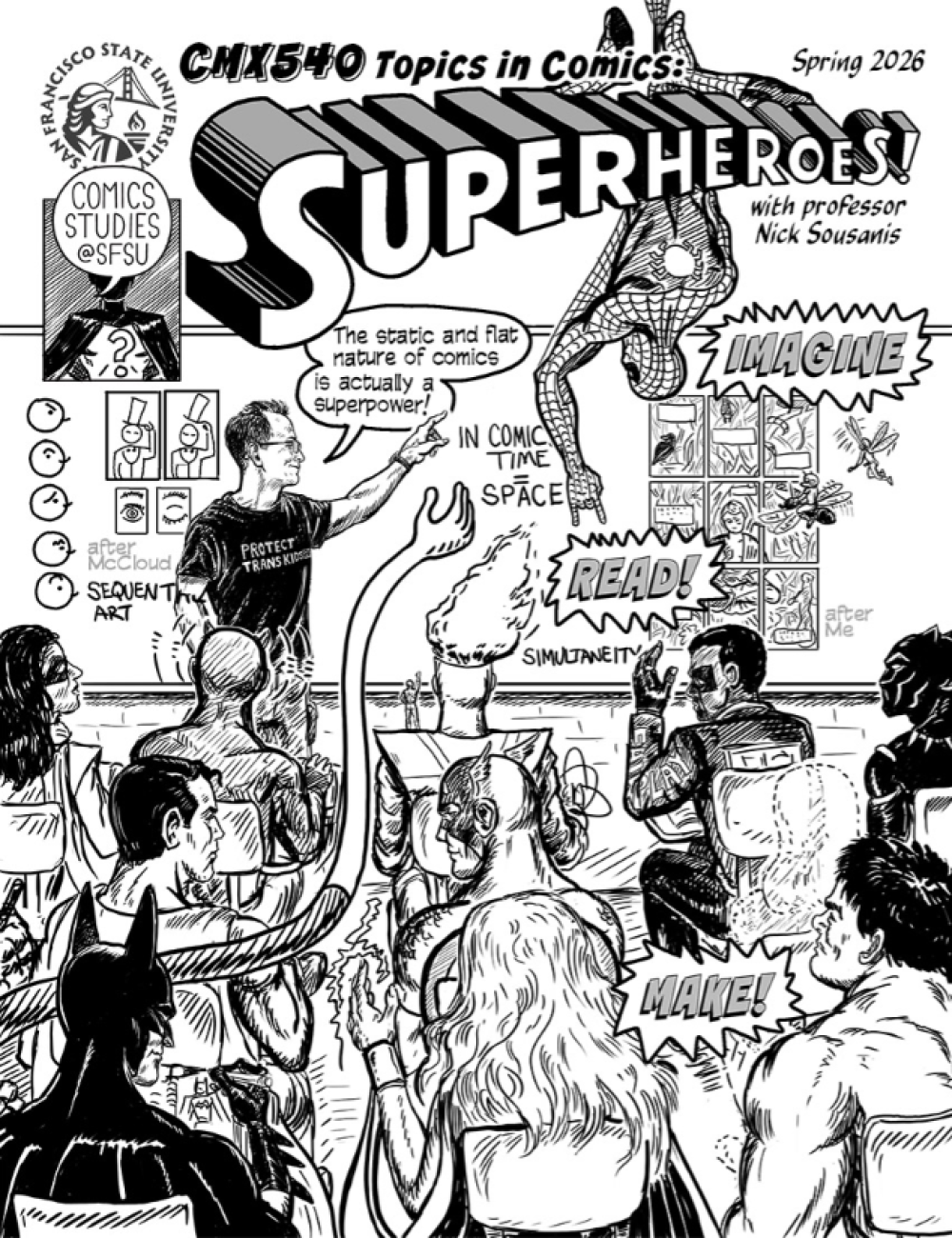
Nick Sousanis is an associate professor of humanities and liberal studies at San Francisco State University, where he started and runs a comics studies program. Given his scholarship, it's appropriate that he has been drawing his syllabi for years. Here's an example, the syllabus for his 2026 course on superheroes, along with notes on the course.

Headshot of Lynn MandeltortHeadshot of Derek Bruff
Lynn Mandeltort, Derek Bruff

Nick's syllabus is the quintessential example of how course learning objectives can be infused in the syllabus form. Visual narrative is at the heart of his creative work and his teaching, so why not have the syllabus reflect that? Students see right away the kinds of learning they will achieve in the course. He also includes plain Word doc versions of the syllabus text. (Note that Nick's dissertation is published as a graphic novel called Unflattening.)

View excerpt
Was this resource helpful?

A Graphic Syllabus as a Visual Welcome to a Biology Course

Grow Beyond Grades

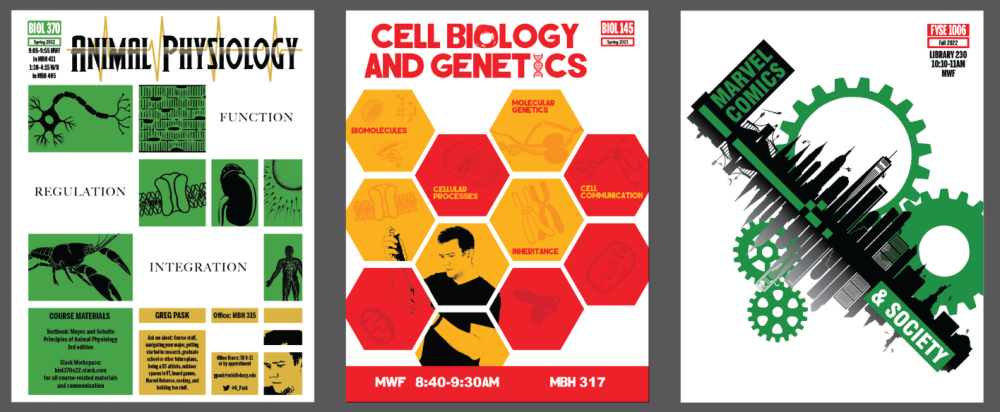
For Middlebury College biology professor, Greg Pask, a graphic syllabus is a chance to establish the tone he wants for a course. Instead of treating the syllabus as a list of rules, penalties, and a code of conduct, the graphic syllabus communicates a “welcome to learning” invitation. In this article, Pask shares before-and-after examples of his syllabi, as well as reflections on the graphic design process.

Headshot of Lynn MandeltortHeadshot of Derek Bruff
Lynn Mandeltort, Derek Bruff

"Perhaps a 10-page monolith of text that looks like a legal document isn’t the best way to help students retain important course information." If you'd like to add more graphic elements to your syllabi to help students better understand course dynamics, read this piece by Greg Pask. It's full of examples and inspiration, as well as practical advice. Note how he uses visuals not just to engage but to convey complex ideas. (Derek was particularly impressed with his riffs on Hawkeye cover artist David Aja's work!)

View excerpt

No matter how much underlining and bold I use in the text-only syllabus (sorry past me!), nothing about it inspires someone to get excited about the course. I’ve found that a graphic syllabus establishes the tone that I want for a course. Instead of treating the syllabus as a list of rules, penalties, and a code of conduct, I try to make it a “welcome to learning” invitation, and the visual components help with that signaling. Though entirely anecdotal, I’ve also found that the classroom energy on the first day of the semester is markedly different. Graphic syllabi (combined with more welcoming and learner-focused language (...)) have been shown to influence students’ opinions of the instructor, finding them to be kinder, more approachable, and more creative (Nusbaum et al 2020). Don’t get me wrong, I’m not in favor of trying to butter up students in order to get glowing evaluations and such. But these are all good things in my opinion, as students’ level of comfort with a professor can do wonders in the learning environment. If my syllabus can contribute to that, it’s a great first step!

I’ve found the welcoming vibe of the graphic syllabi pairs well with my gradeless approach. For several of my students, this is the first time they’ve been in an alternatively-graded course. The graphic syllabus signals up front that things are going to be different. It also allows me to lay out my approach to labor-based assessment in a warm and nonthreatening way, which has led to much calmer first-day discussions of the method. A graphic syllabus and ungrading are certainly not corequisites, but I believe there’s some definite synergy.

Was this resource helpful?

Making a Visual Syllabus Accessible to All Students

Faculty Focus

Teresa Thompson, who designed the Stranger Things-themed syllabus above, is often asked if her visual syllabi are accessible, particularly for students with vision impairments. In this piece, Thompson discusses the ways she remediates her visual syllabi for accessibility.

Headshot of Lynn MandeltortHeadshot of Derek Bruff
Lynn Mandeltort, Derek Bruff

With themes like Stranger Things, Barbie, and Pokemon, Teresa Thompson's Financial Accounting (yes, you read that correctly) syllabi will always catch your eye and keep up with the zeitgeist! All along, though, she maintains the essential elements of accessibility in her designs. Read this article to see how she does it.

View excerpt

I love designing, redesigning, and getting creative with my syllabus. I spend quite a bit of time and effort into creating this document every semester. I know that this may be the first interaction a student has with me and my course, so I grant myself the time to go a little overboard with the syllabus. I believe that all my hard work does have the intended impact. A few semesters ago, I had a student share with me that she dreaded taking accounting, but after receiving my syllabus, she knew she had made the right choice. She said, “A teacher that puts that much effort into the class…cares.” This reduced her anxiety and helped her approach the class with a positive attitude.

Was this resource helpful?

Want to recommend a resource to add to this collection? Send us an email.