
Person typing on computer
Collection

Navigating the AI-Driven Writing Classroom

Generative AI (GenAI) is already changing the landscape of writing courses in multiple ways. The following resources collectively advocate for a thoughtful integration of GenAI, ensuring your students are well-equipped to harness its benefits ethically and effectively.

Updated December 2024
Pary Fassihi headshot
Senior Lecturer in Academic Writing, Research and Digital Media, Faculty Consultant
Boston University College of Arts & Sciences Writing Program
View Bio
01

Generative AI in First-year Writing: An Early Analysis of Affordances, Limitations, and a Framework for the Future

Computers and Composition

The article explores the integration of generative AI tools in first-year composition courses at the University of Mississippi.

Headshot of Pary Fassihi
Pary Fassihi
The authors discuss the benefits of GenAI tools in aiding the writing process, while also highlighting its challenges. A significant value added to the work is the emphasis on reflection, which the authors incorporated into their DEER praxis framework.
View excerpt

Our First-year Writing program began intentional student engagements with generative AI in the fall of 2022. We developed assignments for brainstorming research questions, writing counterarguments, and editing assistance using the AI tools Elicit, Fermat, and Wordtune. Students felt that the tools were helpful for finding ideas to get started with writing, to find sources once they had started writing, and to get help with counterarguments and alternate word choices. But when given the choice to use the assistants or not, most declined. Generative AI at this stage is unreliable, and many students found the tradeoff in reviewing AI suggestions to be too time consuming. And many students expressed a preference for continuing to develop their own voices through writing. Our experience in engaging AI led to the creation of the DEER praxis, which emphasizes defined engagements with AI tools for specific purposes, and generous use of reflection.
Was this resource helpful?
02

Setting Generative AI Expectations in Writing Assignment Guidelines: Critical Review (Mini) Paper Guidelines

Geneva Yang and Pary Fassihi

This sample paper guideline showcases one way you can set GenAI-usage level expectations in your classroom, and guide students through their prompt-engineering and Gen-AI use.

Headshot of Pary Fassihi
Pary Fassihi

Students are often confused with their GenAI-usage level in the classroom due to many reasons, but the most important one being that different instructors have different guidelines. This sample paper guideline shows how we guided students on their GenAI use in different stages of their paper.

View excerpt

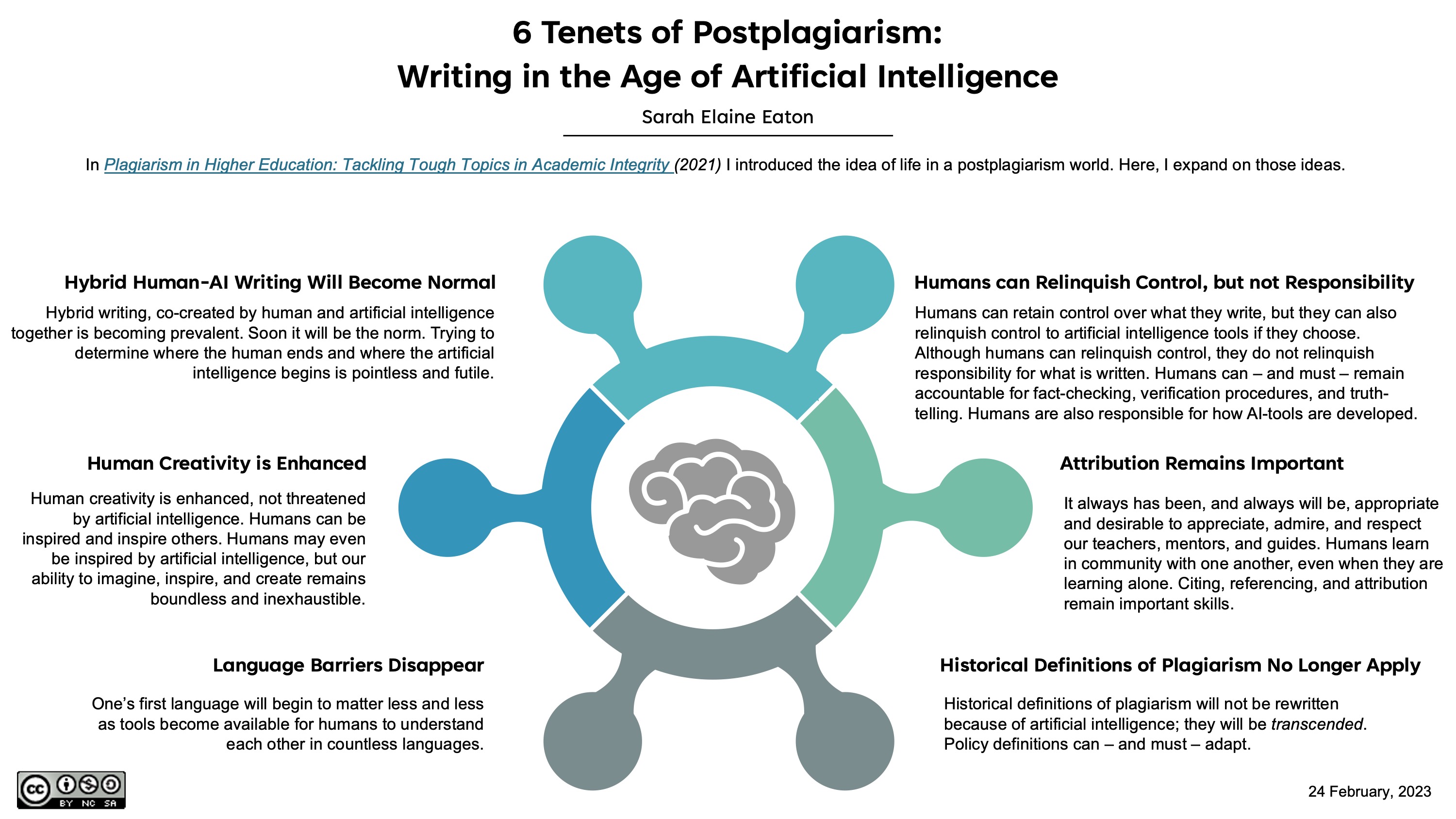
In this paper, you will analyze and critically evaluate the perspectives presented by Sarah Eaton and Maha Bali on the concept of a "post-plagiarism era" in academia. Reflect on the implications of digital technology on academic integrity and authorship, and articulate your own stance on these issues.

Note: The highlighted text in different colors below corresponds to your level of ChatGPT use recommended for each stage of your paper. Here is a color-coded guide for you to see what level of ChatGPT use is recommended for each stage of this paper. Please use this as a guide to determine your level of ChatGPT-use in each area. 

Red: It is better to accomplish independently

Yellow: With minimal help from ChatGPT

Green: With some help from ChatGPT

Was this resource helpful?
03

Appreciation for the Human Perspective

Maria Dikcis

Maria Dikcis teaches her students how to critically work with ChatGPT in their writing, and identify bias and discrimination while doing so.

Headshot of Pary Fassihi
Pary Fassihi
I love Maria Dikcis's creative ways of incorporating ChatGPT into the writing course, especially through the "Me versus ChatGPT" assignment. This allows for students to critically compare their own writing with that of a GenAI's platform and evaluate another piece of writing that is not their own.
View excerpt

Summary from Harvard- Office of the VPAL:

Maria Dikcis teaches her students critical and analytical thinking by using ChatGPT. She has her students write a short essay and then ask ChatGPT to write the same essay based on a prompt. The students then write a brief paper analyzing the assignment and how ChatGPT wrote versus how they wrote the same essay. Dikcis finds that students often find flaws in others writing than their own, and that LLM miss nuances in writing. This assignment gives her students a newfound appreciation for human thought and human creativity.

Was this resource helpful?
04

AI Mini-Games for Peer Review

Neeza Singh and Christopher McVey

AI Mini-Games for Peer Review offers four mini-games students can choose from to get feedback on their papers during class.

Headshot of Pary Fassihi
Pary Fassihi

I love this resource from two Boston University colleagues due to the different focus of each AI mini-game. There is something for every student in your class. These AI mini-games give your students a whole different perspective on peer review, and best of all, students can do this in class with a partner.

View excerpt

AI Mini-Games for Peer Review

Neeza Singh and Christopher McVey
Open resource

The benefits of traditional peer-review are obvious: peer reviewers can offer advice on how to improve your draft, but they are also test readers: by soliciting their curiosity, questions, or even confusion, you will be better able to identify the elements of your draft that work as well as the areas that might need revision or rethinking.

Generative AI, like ChatGPT, can be recruited as a peer reviewer, but it can also do much more! The following four “mini-games” are meant to be played by traditional two-person peer-review partner groups as an alternative to the traditional “read and respond” model of peer review. Partners should read each other’s drafts and choose one of the mini-games below. Each game involves working with ChatGPT in a different way. All games conclude with some time for partners to reflect and discuss.

Was this resource helpful?
05

Future of Writing In the Disciplines and Professions

David Kaufer and Suguru Ishizaki

In this white paper, the authors emphasize their vision of a guided generative AI in the future, one that is properly harnessed and enhances the writing process.

Headshot of Pary Fassihi
Pary Fassihi

I find this white paper and the recommended tool (myScribe) fascinating in the sense that it gives us educators a different perspective on how GenAI can enhance the writing process, while allowing students to focus on higher cognitive skills of critical thinking, analyzing, evaluating and creating.

View excerpt

While AI that creates content may seem to undermine the work of writing educators and the advancements in written communication, we see a different future. We believe that properly harnessed, AI can enhance the writing process, making it more fluid, democratic, and inclusive.

Our vision is guided generative AI, which will free up writers’ time to focus on critical thinking skills, planning, and communicating substantive ideas. This approach will also address the cognitive and motivational barriers that have hindered the scaling of writing education.

Was this resource helpful?

Want to recommend a resource to add to this collection? Send us an email.